Six Central Oregon deck builders checked against state license records, plus the Bend-specific things that decide whether a deck lasts: the 30-inch permit line, snow loads and 18-inch frost footings, the new R327 wildfire rules, Sunriver and HOA review, and what decks actually cost here.
By All Things Bend · Updated October 23, 2026
30 in.Height above grade where a City of Bend deck permit kicks in (stairs, wiring or gas also trigger one)
18 in.Minimum frost depth for footings in Deschutes County
$22,946Average composite deck addition in Medford, Oregon (Cost vs Value 2025)
6builders here, each matched to an active Oregon CCB or LCB license
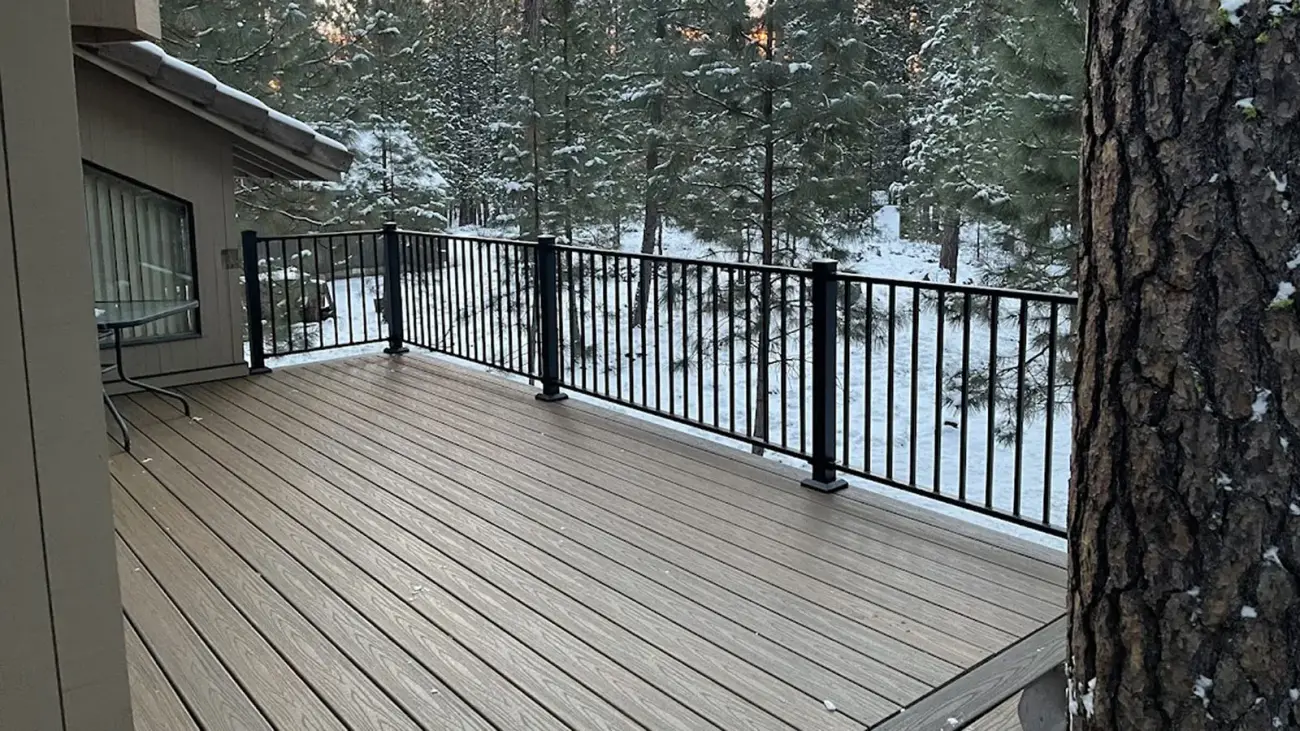
A composite deck with metal railing in the pines. Photo: Webfoot Home Improvements, used with credit.
A deck in Bend has to carry snow, sit through freeze-thaw nights from October to May, bake in high-desert sun all summer and, more and more, stand up to wildfire embers. The best builders here talk about footings, ledger flashing and snow load before they talk about board colors. Use the chooser to find who does your kind of job, then read the permit rules before you sign anything.
What kind of deck job is it?
Tap your job. The list and the compare table below narrow to the companies that do it, with what to know first.
Know first:Ask which line (Trex, TimberTech, others) and whether the builder is a certified installer: the warranty often depends on following the maker’s gap and joist-spacing rules.
Bend permit:Needed if the deck is more than 30 inches above the ground or has stairs, wiring, plumbing or a gas line.
Posted local price:Newport Avenue Landscaping lists $14,000–$22,000 for a 200–300 sq ft composite deck with aluminum railing (2025 guide).
Know first:Cedar and treated lumber need a stain or sealer every few years in Bend sun. Webfoot tells customers to re-stain every 1–3 years.
Bend permit:Same 30-inch / stairs rule as any deck.
Posted local price:Newport Avenue lists $8,000–$14,000 for a basic 200 sq ft pressure-treated deck (2025).
Know first:Refinishing only makes sense if the framing is sound. Probe posts, joists and the ledger with a screwdriver first.
Bend permit:Not needed for cleaning, sanding and staining.
Know first:Ask the builder to check the ledger connection to the house and the footings, not just the boards. Snow and freeze-thaw are hardest on those.
Bend permit:Replacing only the surface boards on existing framing usually doesn’t need one; structural rebuilds and new stairs do. Ask the city.
Know first:A roof adds snow load to the deck below it. Get it designed with the deck, not bolted on later.
Bend permit:Bend requires one for a pergola or patio cover over 12 feet high or over 200 square feet.
Know first:Railing is often the second-biggest cost line. Cable and glass keep the view but cost several times more than wood.
Bend permit:New stairs trigger a Bend building permit.
Posted local price:Newport Avenue lists wood railing at $30–$80 per linear foot installed and cable at $150–$250 (2025).
Bend deck builders worth comparing in 2026
Listed in no particular order. Each was checked on its own website and matched to an active Oregon license on October 23, 2026. Showing all 6.
Deck specialist
Bend Custom Decks
Best for: A deck-only company for a custom composite or wood deck, with 3D design up front
Founded in 2011 and focused almost entirely on decks, arbors and pergolas. It is a Trex Pro Platinum contractor, offers 3D visuals during design, and its site talks specifically about building for Bend’s snow load, sun and temperature swings. Customer reviews on its site mention TimberTech Legacy boards and rebuilding an old cedar deck’s base to modern specs.
Services
Custom deck design and planning, new deck construction, composite and Trex decks, wood decks, deck replacement, arbors and pergolas, hot-tub platforms.
Materials and brands
Trex (Trex Pro Platinum), TimberTech and other composites; premium lumber.
Service area
Bend, Redmond, Sisters, Tumalo, Sunriver, La Pine, Terrebonne, Prineville, Powell Butte, Alfalfa (warehouse at 25250 Cultus Lane, Bend)
Track record
Founded 2011; assumed business name registered Sept. 2011
Oregon license
CCB #235331, Residential General Contractor, held by Kibble Inc of Prineville, which registered “Bend Custom Decks” as its assumed business name; active through April 26, 2027
Best for: Refinishing a wood deck, or a new deck in Sunriver where SROA design review is part of the job
A large Central Oregon exterior company (painting, siding, garages and decks) that says it has 1,300+ five-star reviews. Its deck builds include concrete footings dug below the frost line rather than pier pads, picture-framed edges, breaker boards and hidden fasteners on composite. It is TrexPro Platinum and TimberTech Platinum certified, has built Sunriver decks since 2003, and prepares the full SROA design-review package for Sunriver owners. It also sells standard cedar pergolas (12×12 and 12×16 feet, 10 feet tall) as add-ons.
Services
Deck design and build with 3D renderings, composite and wood decks, deck replacement and structural rebuilds, snow-damage repair, railing rebuilds, second-story decks, sanding and refinishing, stain recoats, annual deck maintenance plans, cedar pergolas, planters and lighting.
Materials and brands
Trex and TimberTech (Platinum certified); cedar and treated wood; oil-based semi-transparent stains for refinishing.
Service area
Central Oregon, including Bend, Sunriver, Caldera Springs and Eagle Crest
Track record
Over two decades in Central Oregon; CCB license since March 2007
Oregon license
CCB #175103, Residential General Contractor, Commercial General Contractor Level 2 and Lead-Based Paint Renovation (Webfoot Painting Co, Bend), active through April 3, 2027
Good to know
Webfoot’s guidance for Central Oregon: re-stain wood decks every 1–3 years, and most decks last 20–30 years with maintenance. Its Sunriver page summarizes SROA review tiers: a like-for-like replacement carries no review fee; a modification is a $100 review fee plus a $150 permit; a substantial alteration is $200 plus $400, and switching from wood to composite is not a like-for-like replacement.
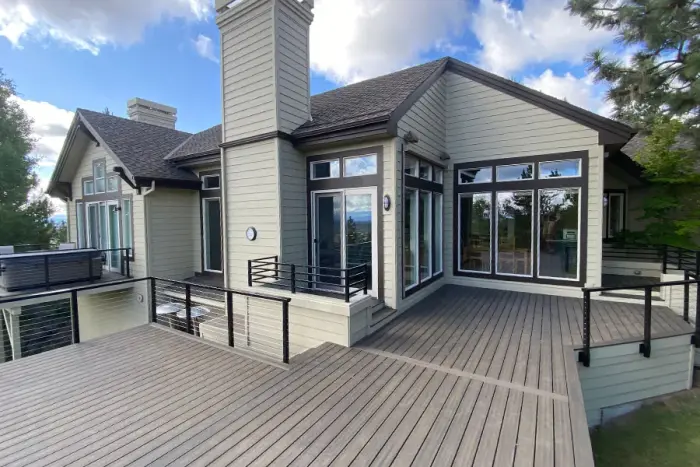
A composite deck with a hot tub. Photo: Webfoot Home Improvements
Remodeler with deck and rot-repair work
Modern Craft Construction
Best for: A deck tied to a bigger remodel, or rot repair where the ledger and framing are the real problem
Brett Riley’s Bend remodeling company (nearly 40 years in the trades) builds composite decks and railing systems with engineered fastening systems, and is blunt that ledger connections, post bases and joist hangers are where decks fail. It says most deck projects take 2–4 weeks, that most Bend decks need a building permit, and that it handles permits and inspections. It also does historic restoration and rot repair.
Services
Deck design and planning, structural foundations and framing, decking in pressure-treated lumber, composite or hardwood, railings and stairs, sealing and finishing, rot repair; also kitchens, baths, windows, doors and ADUs.
Materials and brands
Composite decking and railing systems with engineered fasteners; pressure-treated lumber; hardwood.
Service area
Bend and the greater Central Oregon area
Track record
CCB license since September 2019
Oregon license
CCB #228061, Residential General Contractor (Modern Craft Construction LLC, Bend), active through Sept. 30, 2027
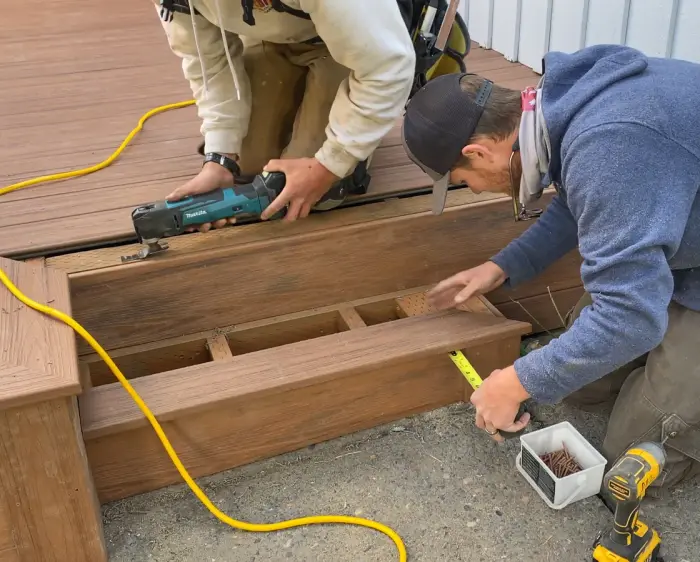
Framing details decide how long a deck lasts. Photo: Webfoot Home Improvements
Fence, deck and siding contractor
Bend Fence & Deck
Best for: A new deck and a fence (or siding) from one crew
Locally owned and run by Brian Wallace and his family, a Bend resident for more than 30 years. The company builds fences, decks, pergolas, siding and replacement windows, says it has built hundreds of decks around Central Oregon, and is a certified TrexPro and TimberTech Elite installer.
Services
Custom decks, composite decks, pergolas and backyard design, fences, siding installation and repair, window replacement.
Materials and brands
Trex and TimberTech (certified installer); wood.
Service area
Bend and Central Oregon
Track record
25+ years of combined experience; CCB license since November 2014
Oregon license
CCB #204674, Residential General Contractor, held by High Desert Builders Inc (Redmond), which registered “Bend Fence & Deck” as its assumed business name; active through Nov. 18, 2026
Good to know
The CCB record shows this license renewing on Nov. 18, 2026. Confirm it is current on the CCB search before you sign.
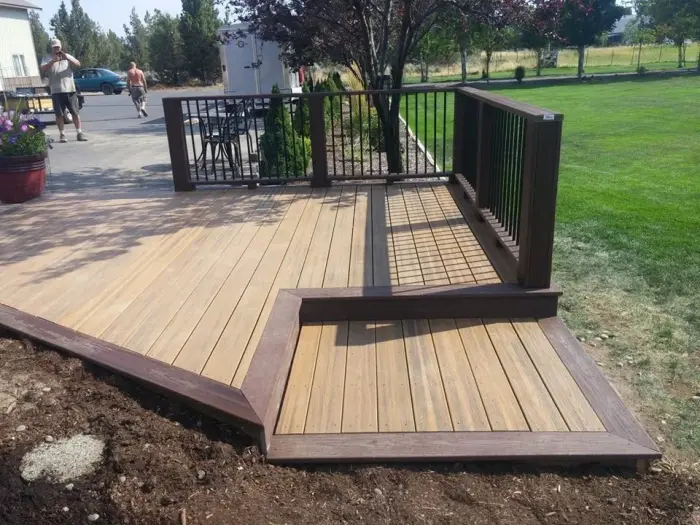
A new low deck with a picture-frame border. Photo: Bend Fence & Deck
Fence and deck builder
Cascade Fence and Construction
Best for: A budget-minded deck, privacy screen or pergola, especially paired with a fence
A family-owned Bend company founded in 2014 by Eric and Chris. Fencing is the core business, but it also builds custom decks in wood and composite, pergolas, privacy screens and modern railing, and it is BBB accredited.
CCB #239972, Residential General Contractor and Commercial General Contractor Level 1 (Cascade Fence and Construction LLC, Bend), active through May 18, 2028
Best for: A deck designed together with the patio, plantings and irrigation around it
Central Oregon’s largest full-service landscape company by its own count (150 employees, 5,000+ projects since 2005). Oregon lets LCB-licensed landscape contractors build decks, and Newport publishes one of the only detailed Bend deck price lists, including railing prices per foot and pergola add-ons. It says it includes permit fees in its quotes.
Services
Decks with pergolas and patio covers, outdoor living, pavers, landscape design and installation, irrigation, maintenance.
Materials and brands
Pressure-treated, cedar, composite (Trex, TimberTech, Fiberon) and tropical hardwood; wood, aluminum, cable and glass railing.
Service area
Bend and Central Oregon (61535 S Hwy 97, Bend; visits by appointment)
Track record
Founded 2005; LCB license active
Oregon license
LCB #9153, All Phases plus backflow (Newport Ave Landscaping LLC, Bend), active through March 31, 2027
Posted prices
From its 2025 Bend deck cost guide: basic 200 sq ft pressure-treated deck $8,000–$14,000; composite 200–300 sq ft $14,000–$22,000; composite with cable railing (300 sq ft) $18,000–$32,000; multi-level composite (400+ sq ft) $28,000–$50,000; deck plus solid-roof cover $28,000–$50,000; repair or refinishing $2,000–$8,000.
✓ = the company lists this work on its own website. License = the state board record on October 23, 2026.
Permits and HOA approval in Bend
The City of Bend’s deck guide is short and specific. Read it before you design, because the 30-inch line changes the cost and timeline of a project.
When Bend requires a permit
The deck or porch is more than 30 inches above the ground
It includes stairs
It includes electrical, plumbing or mechanical work, like a gas line for a grill
A pergola or patio cover is over 12 feet high or over 200 square feet
Any hot tub: the city wants structural plans showing the deck can carry the weight, often with engineer’s calculations, plus an electrical permit and tempered glass on any window or glass door within 5 feet of the tub
What the permit involves
Plans with dimensions, materials and framing, plus a site plan, uploaded through the city’s online permit portal (it has no save button, so have everything ready). The city says fees average $500–$1,000, figured as a percentage of project cost, and review usually takes 2–3 weeks. Expect footing, framing and final inspections.
Even with no permit, the city says check zoning first: setbacks vary by zone (Bend Development Code 2.1.300), decks and patios may cover up to 15% of a lot’s required landscape area, and nothing may sit in a public utility easement.
Questions go to the Permit Center (permitcenter@bendoregon.gov, 541-388-5580) or Planning (planning@bendoregon.gov, ext. 3). Outside city limits, Deschutes County Community Development issues deck permits.
HOAs, Sunriver and resort communities
HOA rules are a second layer on top of the city’s. Many Bend subdivisions have an architectural review committee that approves deck size, railing style, colors and materials, and its approval comes before the permit. Ask for your CC&Rs and design guidelines before you get bids.
Sunriver: every exterior change goes through the Sunriver Owners Association Design Committee, and Webfoot notes that SROA counts a deck toward lot coverage, so a deck that fits your yard may still exceed what you can build. Don’t order materials until you have written approval.
Caldera Springs, Eagle Crest, Discovery West and others have their own review boards. Webfoot keeps community-specific pages for several of them.
Built for Bend: snow, freeze-thaw and wildfire
The house connection matters
Most deck failures start where the deck meets the house. The ledger board has to be bolted (not nailed) to the house framing and flashed so snowmelt can’t run behind it and rot the rim joist. In Bend that water comes in cycles: snow piles on the deck, melts against the siding in the afternoon and refreezes at night. Ask every bidder how they will attach and flash the ledger, and whether they will open up the old one on a replacement.
Footings, frost and snow load
Deschutes County’s building design criteria set a minimum frost depth of 18 inches for footings and say snow load is site specific, taken from the Oregon Snow Load Map. Higher, shadier spots like Sunriver carry more snow than central Bend. Webfoot and Modern Craft both say they dig concrete footings below the frost line rather than setting decks on pier pads, which can heave and shift.
Decks for hot tubs and heavy loads
A filled hot tub with people in it weighs several tons. Bend requires structural plans for a tub on a deck, often with an engineer’s calculations. Tell bidders up front about a tub, an outdoor kitchen, planters or a roof, so the joists, beams and footings are sized for it. Newport Avenue lists hot-tub structural reinforcement at $1,500–$4,000. If the tub can sit on a slab instead, see our hot tub guide and concrete contractors.
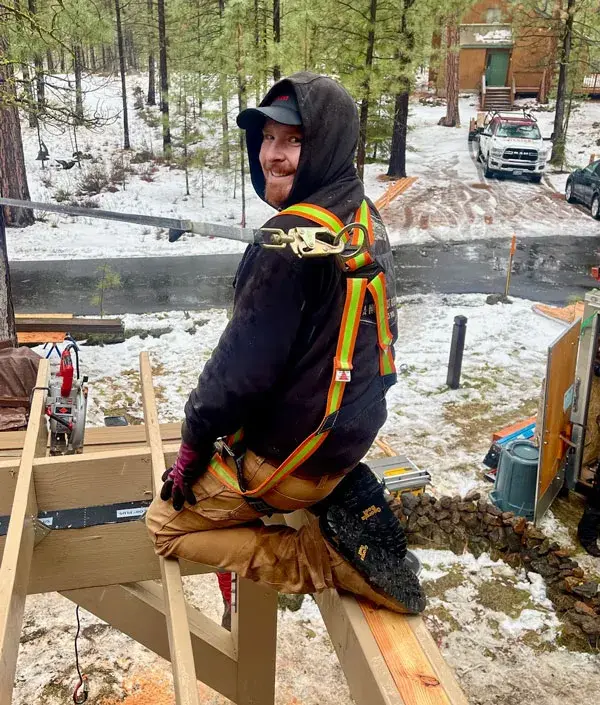
Building through a Central Oregon winter. Photo: Webfoot Home Improvements
Wildfire: R327 and the 0–5 foot zone
The City of Bend adopted Section R327 of the Oregon Residential Specialty Code, effective for permit applications from May 15, 2026. It applies to new homes and new accessory structures, not additions or renovations of existing homes. Unincorporated Deschutes County and Sisters already had it. For decks, R327 says walking surfaces more than 30 inches and less than 12 feet above grade must be ignition-resistant material, exterior fire-retardant-treated wood, noncombustible material or a product that passes the ASTM E2632/E2726 fire tests. Decks of 200 square feet or less built with nominal 2-inch lumber are exempt.
Even when R327 doesn’t apply, the space under and around a deck is where embers land. Bend Fire & Rescue’s Own Your Zone program asks homeowners to clear flammables from under decks and keep the first five feet around the house noncombustible:
Zone 0 · 0–5 feet
Bend Fire & Rescue: remove mulch, leaves, needles and firewood from against walls and under decks, and use noncombustible ground cover such as pavers, crushed stone or mineral soil. The State Fire Marshal adds metal gates or fence sections where a fence meets the house.
Zone 1 · 5–30 feet
Fire-resistant plants, lawn mowed under 4 inches, debris raked, branches pruned back from the house. Keep firewood, lumber and propane tanks 30 feet out.
Zone 2 · 30–100 feet
Hardscape fuel breaks, fewer ladder fuels, trees limbed up (6 feet off the ground on trees taller than 18 feet).
Practical moves: skirt or screen the underside of a low deck with metal mesh, keep firewood and patio cushions off and out from under it, use gravel or pavers below instead of bark, and ask composite makers for their fire test ratings. Our landscaping guide covers fire-resistant planting around the deck.
Wood vs. composite decking in Bend
Most of the builders here now steer Bend customers toward composite, mainly because of UV and freeze-thaw. Wood is still cheaper up front, easy to repair and pleasant barefoot. The decision is really about how much upkeep you want.
Wood decking
Pressure-treated pine and cedar are the local standards; ipe and other hardwoods cost more and last longer. Newport Avenue puts materials at about $3–$6 per sq ft for treated lumber and $5–$9 for cedar. Plan on stain: Webfoot recommends re-staining every 1–3 years in Central Oregon, with oil-based semi-transparent stains.
Composite decking
Trex, TimberTech and Fiberon boards don’t need stain and resist fading and moisture. Newport lists $8–$15 per sq ft for materials. Ask about heat (dark boards get hot in July sun), hidden fasteners, and whether your joist spacing meets the board maker’s spec. Several builders here are Trex or TimberTech certified installers.
PVC and other low-maintenance systems
Capped PVC boards and aluminum decking are lighter and very low maintenance, and aluminum is noncombustible. They cost more. On any system, the substructure underneath is usually still wood, so the framing and ledger details matter just as much.
What about wildfire?
Material alone doesn’t make a deck fire-safe. Under R327 a composite board only qualifies if it passes the listed fire tests, so ask for the product’s rating rather than assuming. Keeping the underside clear of debris does more than any board choice.
Repair, resurface or rebuild?
Refinish when
Boards are gray, dry or splintery but solid
Posts, joists and the ledger are sound
The stain is fading but not peeling everywhere
Resurface when
The framing passes inspection
You want composite on top of an old wood frame
The joist spacing meets the new board’s requirements
Rebuild when
The ledger or rim joist is soft or wasn’t flashed
Posts sit on pier blocks that have moved
The deck bounces, sags or slopes
Railings wobble or stairs are loose
Webfoot says most decks last 20–30 years with maintenance and suggests replacement for a deck over 20 years old with rot or loose boards. Bend Custom Decks describes rebuilding an old cedar deck’s base to current specs before putting composite on top. Newport Avenue lists $2,000–$8,000 for deck repair or refinishing.
Comparing deck bids
Oregon has two contractor boards, and both matter in a yard. The Landscape Contractors Board says a company licensed with either the LCB or the Construction Contractors Board may build decks, patios, fences, retaining walls, walkways and water features. Planting, grading for landscaping, drainage and any irrigation work, including repairs and compressed-air blowouts, needs an LCB license. Look a company up on the CCB search or the LCB search and check that the name on the record matches your contract. Several companies here trade under an assumed business name, so the license holder’s name can differ from the sign on the truck.
Two quotes for “a 300 sq ft composite deck” can describe very different decks. Line them up item by item:
Footing type, size and depth (below the 18-inch frost line)
Joist size and spacing, and whether it meets the board maker’s spec
How the ledger is attached and flashed
Decking brand, line and color
Fasteners: hidden clips or face screws
Railing system and linear feet
Stairs, landings and handrails
Demolition and disposal of the old deck
Permit, plans and engineering (hot tubs, covers)
HOA or SROA submittal, if any
Skirting, mesh or under-deck fire screening
Workmanship warranty and product warranty registration
What a deck costs in Bend
Few Bend builders post prices, so we pulled the two most useful published sources: the 2025 Cost vs Value report (Medford is its closest Oregon market) and Newport Avenue Landscaping’s 2025 Bend deck cost guide. Use them to sanity-check bids, not as quotes.
Published cost ranges with source and date
Item
Range
Source and date
Wood deck addition (16×20 ft)
$15,646 average in Medford; $18,405 Pacific region. Recoups 69.7% at resale in Medford, 102.5% in the Pacific region
Height and stairsAbove 30 inches you need a permit, guards and more structure; every stair run adds framing and railing.
Decking materialNewport’s material ranges run from $3–$6/sq ft (treated) to $12–$22 (hardwood).
RailingOften the second-biggest line. Cable or glass can cost more than the decking.
Snow load and siteSloped lots, tall posts and high-snow sites like Sunriver need bigger beams and more footings.
Tear-outRemoving and hauling an old deck, and fixing rot found under it.
Covers and hot tubsRoofs and tubs need engineering, bigger framing and permits.
Design reviewHOA or SROA fees, drawings and wait time.
SeasonSpring and early summer fill up first; fall and winter slots can open sooner.
Hiring checklist: questions to ask a Bend deck builder
License. What is your CCB (or LCB) number, and whose name is on it? Look it up on the CCB search.
Insurance and bond. Can I see your liability certificate? The CCB record shows the bond on file.
Permit. Does this deck need a City of Bend or county permit, and will you pull it and schedule inspections?
HOA. Will you prepare the drawings for my HOA or SROA review, and will you wait for written approval before ordering?
Footings. What footings will you use, and how deep (18-inch minimum frost depth in Deschutes County)?
Ledger. How will you attach and flash the ledger, and will you open up the old one on a replacement?
Snow load. What snow load are you designing for at my address?
Materials. Which board line and color, which fasteners, and are you certified by that maker?
Fire. How will you handle the space under the deck (skirting, mesh, gravel), and does the board have a fire test rating?
Written contract. The CCB says residential jobs over $2,000 need one, plus the consumer protection notice, notice of procedure and lien information notice.
Schedule and payment. Start date, how long, and a payment schedule tied to progress, not a big deposit up front.
Warranty. What does your workmanship warranty cover, and will you register the product warranty?
Deck builder FAQ
Do I need a permit to build a deck in Bend?
The City of Bend requires a building permit if the deck or porch is more than 30 inches above the ground, if it has stairs, or if it includes electrical, plumbing or gas work. A pergola or patio cover over 12 feet high or 200 square feet also needs one, and so does any hot tub. Fees average $500–$1,000 and review takes about 2–3 weeks, according to the city’s deck guide.
Is composite worth it in Bend?
For most people who plan to stay, yes. Bend’s UV and freeze-thaw cycles are hard on wood finishes, and Webfoot recommends re-staining wood decks every 1–3 years. Composite costs more up front: in the 2025 Cost vs Value report a composite deck addition averaged $22,946 in Medford, Oregon, against $15,646 for wood, and wood recouped slightly more at resale. Composite saves the staining labor and cost over the deck’s life.
Can I put composite boards on my existing framing?
Sometimes. The framing has to be sound, the ledger properly attached and flashed, and the joist spacing has to meet the composite maker’s requirement, which is often tighter than an old wood deck used. Have the builder open up and inspect the frame first. Bend Custom Decks describes rebuilding an old cedar deck’s base to current specs before adding composite.
When is the best time to build a deck?
Builders work most of the year, but footings need unfrozen ground and stain needs dry, mild weather. Spring and early summer book up first, so get bids in winter for a spring build. Late summer and fall are good for staining. Leave time for HOA review and the city’s 2–3 week permit review.
Should I hire a deck specialist or a general contractor?
A specialist like Bend Custom Decks makes sense when the deck is the whole project. A remodeler like Modern Craft fits when the deck is part of a bigger job or the real problem is rot in the house framing. A combined fence-and-deck company like Bend Fence & Deck or Cascade Fence and Construction, or a landscape firm like Newport Avenue, makes sense when the deck is part of a whole-yard plan.
How much does a deck cost in Bend?
Newport Avenue Landscaping’s 2025 Bend guide lists $8,000–$14,000 for a basic 200 sq ft pressure-treated deck, $14,000–$22,000 for a 200–300 sq ft composite deck and $18,000–$32,000 for a 300 sq ft composite deck with cable railing. The 2025 Cost vs Value report puts a 16×20 composite deck addition at $22,946 in Medford, Oregon.
Does the new R327 wildfire code apply to my deck?
In the City of Bend, R327 took effect May 15, 2026 for new homes and new accessory structures. The city says it does not apply to additions or renovations of existing homes. Where it applies, deck walking surfaces between 30 inches and 12 feet above grade must be ignition-resistant, fire-retardant-treated, noncombustible or a product that passes the listed fire tests, with an exception for decks of 200 sq ft or less built with nominal 2-inch lumber.
How often should I stain a wood deck in Bend?
Webfoot, which refinishes many Central Oregon decks, says every 1–3 years depending on the wood, the stain’s tone and opacity, and sun exposure, and recommends oil-based semi-transparent stains. A simple test: sprinkle water on the boards. If it soaks in instead of beading, it’s time.