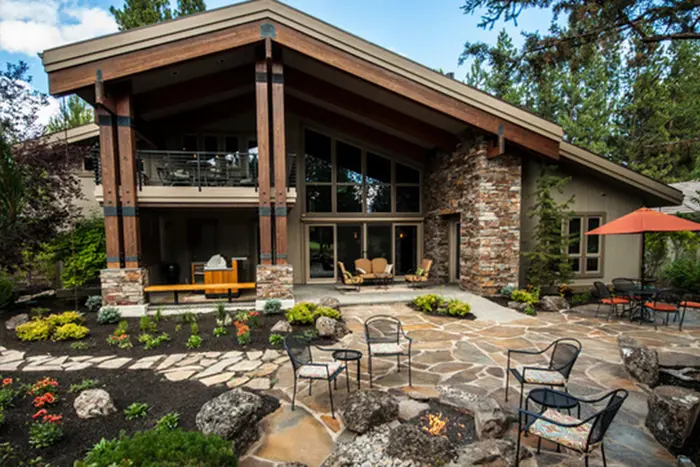
Six Bend landscaping companies checked against Oregon Landscape Contractors Board records, plus the high-desert basics: waterwise plants and drip, the City of Bend’s $3-per-square-foot lawn removal rebate, sprinkler winterization, fire-resistant zones around the house, HOA rules and posted local prices.
By All Things Bend · Updated October 23, 2026
$3/sq ftCity of Bend turf replacement rebate, up to $3,000 (2026 terms)
3–6 in.Rain in a typical Central Oregon growing season, April–October (OSU Extension)
0–5 ftZone next to the house Bend Fire wants free of bark mulch and plants
6landscapers here, each matched to an active Oregon LCB license
Bend is high desert at about 3,600 feet: short growing season, frost possible in almost any month, pumice soil that drains like a sieve, deer, and summers with almost no rain. OSU Extension says outdoor watering is over half of a typical Central Oregon household’s water use. Good local landscapers design around all of that: plants grouped by water need, drip instead of spray in beds, less lawn, and a fire-safe band around the house. The City of Bend will now pay you to take out lawn.
What kind of landscaping help do you need?
Tap your job. The list and the compare table below narrow to the companies that do it, with what to know first.
Know first:Ask for a plan that shows plants by water zone, irrigation type per zone, and mature plant sizes, not just a pretty rendering.
Posted local price:Newport Avenue posts $20,000–$80,000+ for full design and installation.
Know first:Fall and spring are the planting seasons. Ask about soil prep in pumice and the plant warranty (Newport states 90 days on plants).
Know first:All irrigation work, including repairs and blowouts, legally needs an LCB-licensed contractor. Ask about a WaterSense smart controller: the city rebates $100.
Posted local price:Newport Avenue posts $1,600–$2,000 per zone for a new system and $140 per tech hour for repairs and winterization.
Know first:Ask what is included each visit, whether they adjust the controller through the season, and who handles startup and blowout.
Posted local price:Newport Avenue posts weekly mowing from $97 per service and spring or fall cleanups from $600.
Know first:Apply for the City of Bend turf rebate and get the city consultation before any turf comes out, or you lose the rebate.
Posted local price:Newport Avenue posts $8,000–$20,000 for a 1,000 sq ft front-yard conversion. The city rebate on that area would be $3,000.
Know first:Start with the first five feet: rock or pavers instead of bark, no junipers against the house. Bend Fire & Rescue offers wildfire risk home assessments.
Bend landscaping companies worth comparing in 2026
Listed in no particular order. Each was checked on its own website and matched to an active Oregon license on October 23, 2026. Showing all 6.
Design-build and maintenance firm
Newport Avenue Landscaping
Best for: A large project with design, hardscape, irrigation and ongoing maintenance from one company
Founded in 2005 and, by its own count, Central Oregon’s largest full-service landscape company: 150 employees, 5,000+ projects and in-house crews without subcontractors, working for homeowners, HOAs, builders and commercial properties. It publishes unusually detailed Bend prices and offers firewise assessments, juniper removal and fire-resistant replanting.
Services
Landscape design and installation, xeriscape and waterwise landscaping, firewise landscaping and juniper removal, irrigation installation, repair, activation and blowouts, smart controllers, drainage, pavers, retaining walls, outdoor living, lighting, lawn care, maintenance plans, snow removal.
Materials and brands
Drip and rotor/spray systems from Rain Bird, Hunter, Toro and others; fire-resistant plants such as yarrow, stonecrop, snowberry, currant and aspen.
Service area
Bend, Redmond, Sisters, Sunriver, Tumalo, Prineville, La Pine, Madras, Eagle Crest, Powell Butte and more
Track record
Founded 2005
Oregon license
LCB #9153, All Phases plus backflow (Newport Ave Landscaping LLC, Bend), active through March 31, 2027
Posted prices
Weekly mowing from $97 per service; “Everything” maintenance plan from $388/month; spring or fall cleanup from $600; new sprinkler system $1,600–$2,000 per zone; repair, startup and winterization $140 per tech hour; xeriscape front yard (1,000 sq ft) $8,000–$20,000.
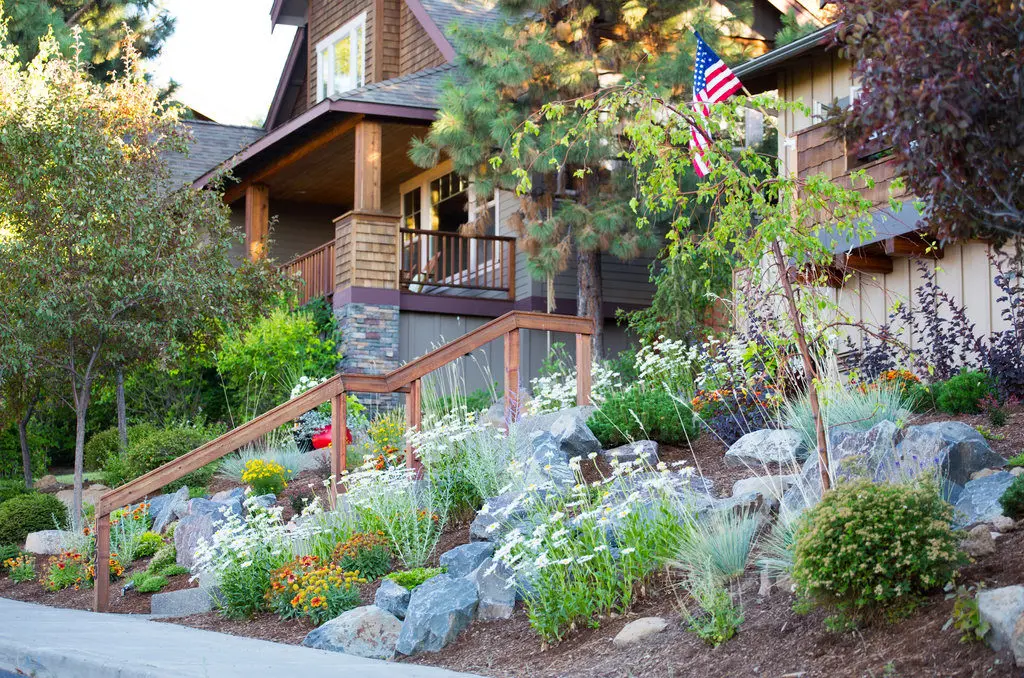
A new landscape install in east Bend. Photo: Newport Avenue Landscaping
Design, construction and maintenance since 1979
Butch & Troy Landscaping
Best for: A long-established local company with owner access, for residential or commercial work
Founded in 1979 in Bend, one of the oldest landscaping companies in town. It offers design, residential and commercial construction, water features, hardscapes, irrigation, maintenance, snow removal and sprinkler blowouts, and says customers can reach the primary owner directly. Its site lists both its company license (LCB #7158) and an individual landscape construction professional license (LCP #12299).
Best for: Waterwise irrigation: a new system, a drip conversion, repairs or backflow work
An owner-operated Bend landscaping and irrigation business serving Central Oregon for more than fifteen years. It specializes in water-wise irrigation and handles new systems, repairs and upgrades, spring startups, and backflow device installation and repair.
Services
New irrigation system installation, repairs and upgrades, system startups, backflow device installation and repair.
Service area
Central Oregon
Track record
15+ years
Oregon license
LCB #8952, All Phases plus backflow (Complete Irrigation Services LLC, Bend), active through Sept. 30, 2027
Best for: A residential install with sprinklers, pavers or a retaining wall, and plant advice
Family-owned and in Oregon since 1991, with more than 20 years in irrigation and landscaping, including work with Cascade Gardens and Eastside Gardens. It specializes in irrigation systems, pavers and retaining walls, and offers garden design and advice on plants and trees suited to the area.
Services
Residential landscaping, sprinkler system installation, pavers and retaining walls, garden design.
Service area
Bend and Central Oregon (LCB address in Redmond)
Track record
In Oregon since 1991; LLC registered 2020
Oregon license
LCB #9598, All Phases plus backflow (A & E Landscape & Irrigation LLC, Redmond), active through Feb. 28, 2027
Checked October 23, 2026: A&E home page, Oregon LCB record.
Sustainable design and maintenance
Accent Landscape Design & Construction
Best for: A lower-water, lower-chemical landscape or lawn renovation
A Bend company with more than 25 years of hands-on local experience. It focuses on “sensible landscape practices”: practical plants, efficient irrigation and LED low-voltage lighting, sprinkler service with newer water-saving heads, organic fertilizers and fewer chemicals in maintenance, and lawn renovations that use less water.
Services
Design and installation, irrigation service and retrofits, LED landscape lighting, maintenance with organic fertilizers, lawn renovation.
Service area
Bend
Track record
25+ years in the Bend landscape industry
Oregon license
LCB #8938, All Phases plus backflow (Accent Landscape Design & Construction LLC, Bend), active through July 31, 2027
Best for: Maintenance in an HOA neighborhood, or a low-water “zero maintenance” redesign
Creating and servicing Bend landscapes for more than 20 years. It designs, installs and maintains, specializes in irrigation design, installation and repair, and points out that its maintenance (pruning, mowing, weeding, cleanups) suits neighborhoods with CC&R upkeep rules. Its designs include plants with little to no water needs, rock features, cinders and pavers.
Services
Landscape design and installation, new-construction landscaping, yard renovations, pavers, water features, irrigation design and repair, startups and blowouts, backflow testing, maintenance, spring and fall cleanups, snow removal.
Service area
Bend and surrounding Central Oregon (222 SE 9th St.)
Track record
20+ years in Bend
Oregon license
LCB #8158, All Phases plus backflow (Blake And Sons Landscape Maintenance Inc, Bend), active through Dec. 31, 2026
✓ = the company lists this work on its own website. License = the state board record on October 23, 2026.
Start with the kind of project you actually need
Landscape design
A plan for layout, plants, hardscape, drainage and irrigation zones. Worth paying for on a new build or a full makeover, because it’s where water use gets decided.
Landscape installation
Grading, soil prep, planting, irrigation, rock, paths and patios. Get the plan and plant list attached to the contract.
Maintenance
Mowing, pruning, weeding, cleanups, fertilizing and seasonal irrigation adjustments. Many Bend HOAs require yard upkeep in their CC&Rs.
Irrigation service
Spring startup, repairs, controller programming, drip conversions, backflow testing and fall blowout. Licensed LCB work by law.
Oregon has two contractor boards, and both matter in a yard. The Landscape Contractors Board says a company licensed with either the LCB or the Construction Contractors Board may build decks, patios, fences, retaining walls, walkways and water features. Planting, grading for landscaping, drainage and any irrigation work, including repairs and compressed-air blowouts, needs an LCB license. Look a company up on the CCB search or the LCB search and check that the name on the record matches your contract. Several companies here trade under an assumed business name, so the license holder’s name can differ from the sign on the truck.
Verify licensing
Search the company on the LCB register. The record shows status, expiration and “phase”: All Phases covers construction, planting and irrigation, and Plus Backflow means the business may install backflow devices. Every company on this page was active, All Phases plus backflow, on October 23, 2026.
High-desert landscaping principles that matter
Match plants to exposure
South and west walls bake; north sides stay frozen into spring. Frost can come in June or September, so pick plants hardy for your exposure, not just for “Bend.”
Improve soil where needed
Much of the Bend area sits on light, fast-draining pumice and ash from Mount Mazama. Lawns and vegetable beds need compost worked in; many native and waterwise plants prefer it lean.
Group plants by water needs
OSU Extension’s Waterwise Gardening in Central Oregon (EM 9136) puts hydrozoning, grouping plants with similar water needs on the same valve, at the center of a waterwise yard. The City of Bend rebate requires it too: no mixed hydrozones.
Mulch thoughtfully
Mulch saves water, but bark is combustible. Use rock or gravel in the first five feet around the house and organic mulch farther out. The city’s turf rebate wants 3 inches of air- and water-permeable mulch, and no plastic weed barrier.
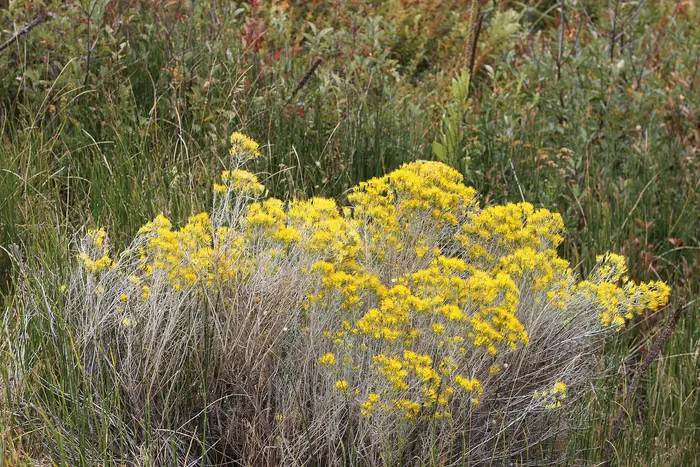
Rabbitbrush (chamisa) in bloom near Steelhead Falls. Photo: Stephen Baker, Bureau of Land Management, public domain
Xeriscaping does not mean “no plants”
A waterwise Bend yard is full of plants: OSU Extension notes it can include trees, shrubs, evergreens, perennials and grasses, not only natives. What changes is the watering. The City of Bend’s rebate rules spell out what the city considers a real conversion: whole irrigation zones, plants spaced to cover half the area within five years, drip irrigation with pressure regulation and filters, and no artificial turf or bare rock fields.
City of Bend water rebates (2026 terms)
Turf replacement: $3 per square foot of living lawn removed, up to $3,000. You must be a City of Bend water customer with a working irrigation system and backflow, convert whole irrigation zones, get a city consultation and written approval before removing turf, cover the area with 3 inches of permeable mulch, plant for 50% coverage in five years (about ten plants per 100 sq ft) on drip, and keep it that way for five years. No artificial turf, bare soil, plastic weed barrier or new concrete or asphalt in the area.
Outdoor devices (bill credit, product cost only, installed April 1–October 31 with an inspection): WaterSense smart irrigation controller $100 (one), drip conversion kit $90 (one), high-efficiency rotary nozzles $4 each (up to 20), pressure-regulating spray bodies $4 each (up to 20). Retrofits only, not new construction.
Timing: the 2026 turf season opened April 1; projects had to be finished by October 15 and inspected by October 31, so plan a 2027 project over the winter and apply when the city reopens the program. Funds are first-come, first-served.
Not on city water? Avion Water, which serves more than 16,000 customers in Deschutes and Crook counties, lists no rebate program on its site; it offers free water-conservation tools at its office while supplies last. Check with your own provider.
Questions: City of Bend Water Conservation, 541-317-3000 ext. 2, conservation@bendoregon.gov. Rules from the city’s turf rebate and residential rebate pages, checked October 23, 2026.
Plants that often fit Central Oregon conditions
OSU Extension’s EM 9136 includes a searchable plant list for Central Oregon by water use, height and other traits, and the city points rebate applicants to it. Plants Bend landscapers commonly use include:
Rabbitbrush and other native shrubs
Mountain mahogany
Oregon grape
Penstemon
Yarrow (also on Newport’s fire-resistant list)
Lavender
Stonecrop and sedum groundcovers
Snowberry and currant
Native bunchgrasses
Aspen and other deciduous trees (lower flammability)
Keep lawn where kids and dogs actually play, and convert the strips, slopes and front-yard showpieces. Lawn is the thirstiest part of most Bend yards, and Newport Avenue estimates outdoor water use can drop 50–70% after a xeriscape conversion. If you do keep lawn, Bend Fire & Rescue wants it mowed under 4 inches in the 5–30 foot zone.
Irrigation is the backbone of many Bend landscapes
With 3–6 inches of rain in a typical growing season (OSU Extension), almost every Bend yard depends on its system. The biggest wins:
Drip in beds, sprays and rotors only on lawn
Never mix rotors and sprays on one zone
A WaterSense smart controller ($100 city rebate)
High-efficiency rotary nozzles ($4 each rebate, up to 20)
Pressure-regulating spray bodies ($4 each, up to 20)
Fix overspray onto sidewalks: Bend Code 14.20.30 defines runoff and overspray as water waste
A working backflow device, tested as required
Seasonal controller changes, not one summer schedule
How often should it run?
Usually not for established plants. Deeper, less frequent watering grows deeper roots; pumice soils may need shorter cycles repeated (cycle and soak) so water soaks in instead of running off. A smart controller adjusts to weather automatically.
Sprinkler winterization
Bend averages about 14 freezing nights in October and 21 in November (NOAA 1991–2020), so systems need blowing out with compressed air before hard freezes, usually late September to mid-October. Blowouts are licensed LCB work. Newport Avenue posts $140 per tech hour for winterization. See our Bend sprinkler blowout guide for companies and timing.
Fire-aware landscaping
Bend Fire & Rescue says 90% of homes that burn in wildfires are ignited by embers, which can travel more than a mile ahead of a fire and land in mulch, needles and dry plants next to the house. Its Own Your Zone program breaks the yard into three zones:
Zone 0 · 0–5 feet
Bend Fire & Rescue: remove mulch, leaves, needles and firewood from against walls and under decks, and use noncombustible ground cover such as pavers, crushed stone or mineral soil. The State Fire Marshal adds metal gates or fence sections where a fence meets the house.
Zone 1 · 5–30 feet
Fire-resistant plants, lawn mowed under 4 inches, debris raked, branches pruned back from the house. Keep firewood, lumber and propane tanks 30 feet out.
Zone 2 · 30–100 feet
Hardscape fuel breaks, fewer ladder fuels, trees limbed up (6 feet off the ground on trees taller than 18 feet).
Move junipers and other oily shrubs away from the house (Newport calls western juniper the region’s top landscape fire risk)
Replace bark against the foundation with rock or pavers
Keep irrigated, green plants in the 5–30 foot zone
Prune branches 10 feet from roofs and eaves
Keep firewood 30 feet away
Take yard debris to Deschutes County’s free FireFree recycling in spring instead of burning it
Bend Fire & Rescue offers wildfire risk home assessments, and more than 40 Bend neighborhoods are Firewise USA communities. Since May 15, 2026, new homes in Bend also have to meet the R327 wildfire building code; R327 covers the building, not the landscape around it.
Pavers, patios and retaining walls
Many landscapers also build hardscape. Retaining walls over 4 feet, or holding up a building or driveway, need a City of Bend building permit (6 feet max), and fences have height limits. See our paver installation guide, fence companies guide and retaining walls guide.
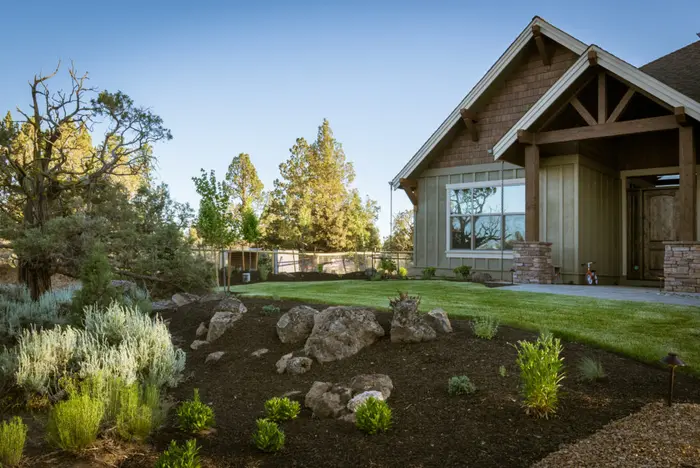
A flagstone patio and xeriscape in Broken Top. Photo: Newport Avenue Landscaping
New construction landscaping and HOAs
New Bend subdivisions usually come with CC&Rs that set a deadline to finish front-yard landscaping, an architectural review step, and sometimes a minimum or maximum lawn area or an approved plant list. Read them before you design, and get written approval. Builders who plant as part of a new home can only do up to $4,600 of landscape work per house under a CCB license, and no irrigation, according to the LCB; the rest needs an LCB-licensed landscaper. The City of Bend’s outdoor device rebates don’t apply to new construction, and the turf rebate requires existing living lawn, so a new yard designed waterwise from day one is the cheapest path.
What a landscaping proposal should include
A scaled plan with plant names, sizes and quantities
Hydrozones and irrigation type per zone
Controller model (WaterSense for the rebate)
Soil prep and amendments
Mulch type and depth, with rock in the 0–5 foot zone
Lawn removal method and haul-off
Hardscape, walls and permits
Drainage and downspouts
Lighting
Plant and irrigation warranties
Establishment watering instructions
Payment schedule and LCB number
What landscaping costs in Bend
Newport Avenue Landscaping publishes the most detailed Bend price list; other companies here quote by project. Treat these as planning ranges.
Size and accessSquare footage and whether equipment can reach the backyard.
Lawn removalSod cutting or sheet mulching, and haul-off.
IrrigationPriced per zone; drip conversions add pressure regulators and filters.
Plant sizeGallon pots establish well and cost far less than large specimens.
Rock and bouldersDelivery and placement of rock, cinders and boulders.
HardscapePatios, walls and paths are often the biggest line.
Fire workJuniper removal, stump grinding and limbing.
RebatesThe city turf and device rebates can offset part of it if you plan ahead.
Hiring checklist: questions to ask a Bend landscaper
License. What is your LCB number, and does it cover all phases and backflow? Check the LCB register.
Water. How will you group plants by water need, and which zones will be drip?
Rebate. Have you done City of Bend turf-rebate projects, and will the design meet its rules?
Controller. Which controller, and is it WaterSense labeled?
Soil. What soil prep do you recommend for my pumice soil?
Plants. Which plants, what sizes, and how many per 100 sq ft?
Fire. What goes in the first five feet, and will you move junipers or bark away from the house?
HOA. Will you prepare the plan for HOA review?
Warranty. How long are plants and irrigation guaranteed, and what voids it?
Seasonal care. Who handles startup, controller changes and blowout?
811. Who requests utility locates before digging?
Contract. A written proposal with plan, plant list, schedule and payment terms.
Landscaping FAQ
When is the best time to plant in Bend?
Late spring after the last hard frosts and early fall are the main windows. Bend averages 9 freezing nights in May and about 14 in October (NOAA 1991–2020), so tender plants wait until late May or June. Fall planting gives roots time before winter, as long as plants get watered until the irrigation is blown out.
Do native plants need no irrigation?
Not at first. Even drought-tolerant natives need regular water for their first season or two to establish roots. After that many need little. The City of Bend’s turf rebate requires drip irrigation for new plantings for that reason.
Is artificial turf a good solution?
It saves water, but it gets very hot in Bend sun, doesn’t cool the yard, and the City of Bend’s turf rebate explicitly excludes it: lawn can’t be replaced with artificial turf or bare soil. Living low-water plantings on drip qualify for $3 per square foot.
Should irrigation run every day?
Usually not for established landscapes. Water deeply and less often to build deeper roots, use cycle-and-soak programs on pumice soil, and let a WaterSense smart controller adjust to weather. The City of Bend rebates $100 toward one.
Does the City of Bend pay you to remove your lawn?
Yes, if you’re a City of Bend water customer. The 2026 turf replacement rebate paid $3 per square foot of living lawn removed, up to $3,000, for projects approved before work started, converted by whole irrigation zone, planted for 50% coverage within five years and watered by drip. The 2026 season ran April 1 to October 31.
Does Avion Water offer landscaping rebates?
Avion Water’s website listed no rebate program when we checked on October 23, 2026. It offers free water-conservation tools at its office while supplies last. City of Bend rebates only apply to City of Bend water customers.
Do landscapers need a license in Oregon?
Yes, for paid landscape construction. The Oregon Landscape Contractors Board requires a license for planting, landscape grading, drainage and all irrigation work, including sprinkler repairs and compressed-air blowouts. Mowing and basic yard maintenance without irrigation work generally doesn’t need one.
What plants are fire-resistant in Bend?
No plant is fireproof, but well-watered, low-growing plants with high moisture content burn less readily. Newport Avenue’s firewise list for Bend includes yarrow, stonecrop and sedum, snowberry, currant and deciduous trees like aspen. Keep junipers and bark mulch out of the first five feet around the house, per Bend Fire & Rescue.
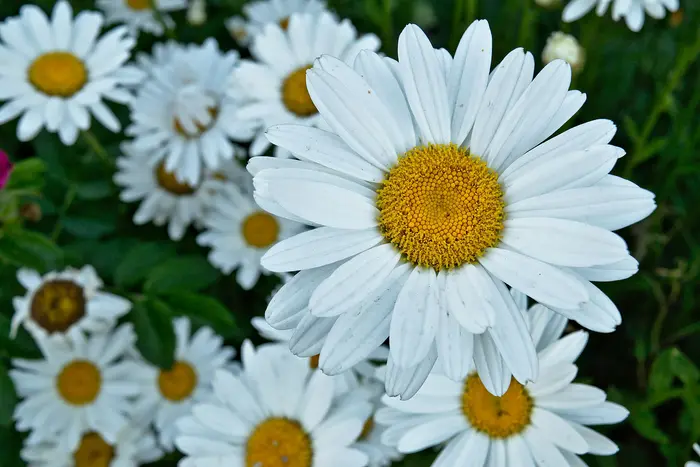
Photos: landscape photos by Newport Avenue Landscaping, from its website, credited on each image. Rabbitbrush by Stephen Baker, Bureau of Land Management (public domain); daisy garden by Trougnouf (CC BY 4.0), via Wikimedia Commons.
Know something we should add or update?All Things Bend is built to stay useful, not frozen in time.