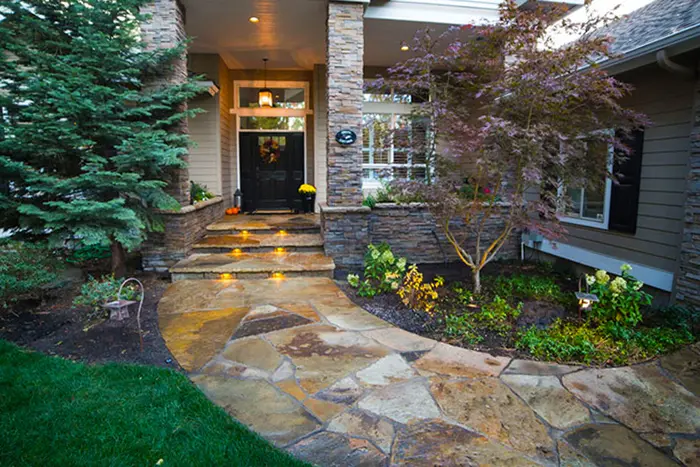
Four Bend hardscape companies checked against state license records, plus what makes a paver patio survive about 168 freezing nights a year on pumice soil: base depth, edge restraint, drainage, fire-safe zones next to the house, Bend’s retaining wall and right-of-way rules, and posted local prices.
By All Things Bend · Updated October 23, 2026
168nights a year at or below 32°F in Bend, on average (NOAA)
6–8 in.Compacted crushed-rock base Newport Avenue recommends in Bend’s pumice soils
$8k–$16kPosted Bend range for a basic 200–400 sq ft concrete paver patio
4hardscape companies here, each matched to an active Oregon LCB license
Pavers suit Bend: they flex with frost instead of cracking like a slab, a stained or settled piece can be lifted and replaced, and a paver or gravel band is exactly what fire officials want in the first five feet around a house. They only work if the base under them is right. Bend’s light pumice soil drains fast but compacts poorly, and water that sits in the base freezes most nights from October to May. Ask installers about the base before you ask about colors.
What are you building?
Tap your job. The list and the compare table below narrow to the companies that do it, with what to know first.
Know first:Slope it away from the house, plan where downspouts and sprinklers drain, and decide now on a fire pit, hot tub or future pergola.
Bend permit:An at-grade patio usually needs none. Decks and patios together may cover up to 15% of a lot’s required landscape area.
Posted local price:Newport Avenue posts $8,000–$16,000 for a basic 200–400 sq ft concrete paver patio.
Know first:Walks get the most shoveling. Ask for a texture that’s safe when icy and edges that a snow shovel won’t catch.
Posted local price:Newport Avenue posts $45–$90 per linear foot for a paver walkway.
Know first:Driveways need thicker pavers and a deeper base. Bend doesn’t allow pavers in the street right-of-way: the apron from the curb must be concrete.
Bend permit:A city right-of-way permit for any new or changed curb cut or approach.
Posted local price:Newport Avenue posts $18–$35 per sq ft for a paver driveway.
Know first:Keep wood-burning fire pits well away from the house, fences and trees, and check Bend Fire & Rescue’s current burn rules.
Posted local price:Newport Avenue posts $16,000–$35,000 for a 400–800 sq ft patio with a fire pit.
Know first:Block walls need a drainage layer behind them. Boulder walls are common in Bend and suit basalt-rock lots.
Bend permit:Over 4 feet, or holding up a building or driveway, needs a Bend building permit; 6 feet is the max.
Know first:Ungrouted flagstone on gravel drains and flexes; mortared flagstone on a slab can crack in freeze-thaw.
Bend paver and hardscape companies worth comparing in 2026
Listed in no particular order. Each was checked on its own website and matched to an active Oregon license on October 23, 2026. Showing all 4.
Design-build landscape firm
Newport Avenue Landscaping
Best for: A full outdoor-living project with pavers, walls, a fire pit and planting under one contract
Founded in 2005 and, by its own count, Central Oregon’s largest full-service landscape company, with 150 employees and in-house crews rather than subcontractors. It publishes detailed Bend paver prices, recommends pavers rated for ASTM C936 freeze-thaw testing and 6–8 inches of compacted crushed rock base in pumice soil, and says a typical residential patio takes 3–7 days.
Services
Paver patios, walkways, driveways and pool decks; natural stone (flagstone, basalt, slate); permeable pavers; boulder and block retaining walls; fire pits, outdoor kitchens and seating walls; pergolas; landscape design, irrigation and maintenance.
Bend, Redmond, Sisters, Sunriver and all of Central Oregon
Track record
Founded 2005
Oregon license
LCB #9153, All Phases plus backflow (Newport Ave Landscaping LLC, Bend), active through March 31, 2027
Posted prices
Basic concrete paver patio (200–400 sq ft) $8,000–$16,000; mid-size patio with fire pit (400–800 sq ft) $16,000–$35,000; full outdoor living space (800+ sq ft) $35,000–$80,000+; paver walkway $45–$90 per linear foot; paver driveway $18–$35 per sq ft.
Good to know
Warranty stated on its site: plants 90 days, irrigation 1 year.
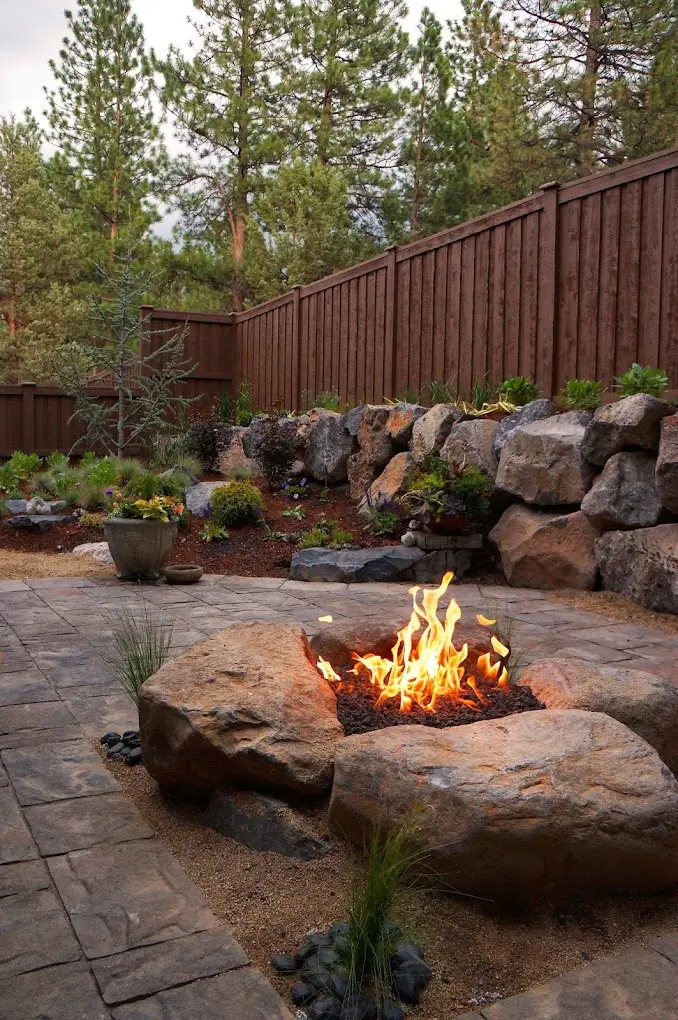
Setting pavers around a fire pit. Photo: Newport Avenue Landscaping
Family landscape and irrigation company
A&E Landscape & Irrigation
Best for: Pavers and a retaining wall installed together with irrigation and planting
A family-owned company in Oregon since 1991 whose team has more than 20 years in irrigation and landscaping, including work with Cascade Gardens and Eastside Gardens. It lists irrigation systems, pavers and retaining wall installation as its specialties, plus garden design and plant advice.
Services
Paver and retaining wall installation, sprinkler system installation, residential landscaping, garden design.
Service area
Bend and Central Oregon (LCB address in Redmond)
Track record
In Oregon since 1991; LLC registered 2020
Oregon license
LCB #9598, All Phases plus backflow (A & E Landscape & Irrigation LLC, Redmond), active through Feb. 28, 2027
Checked October 23, 2026: A&E home page, Oregon LCB record.
Full-service landscape company
Blake & Sons Landscape
Best for: A paver patio, path or driveway from a company that will also maintain the yard
A Bend landscape company for more than 20 years that designs, installs and maintains landscapes. It says it has extensive experience designing and installing pavers for patios, paths, walkways and driveways, and also builds water features and offers low-water “zero maintenance” designs with rock features and ground covers.
Services
Paver patios, walkways and driveways; landscape design and installation; water features; irrigation design, repair, startups, blowouts and backflow testing; maintenance and cleanups; snow removal.
Service area
Bend and surrounding Central Oregon (222 SE 9th St., Bend)
Track record
20+ years in Bend
Oregon license
LCB #8158, All Phases plus backflow (Blake And Sons Landscape Maintenance Inc, Bend), active through Dec. 31, 2026
Best for: Hardscape as part of a larger residential or commercial landscape, with direct access to the owner
A Bend landscaping company founded in 1979 that offers design, residential and commercial construction, water features, hardscapes, irrigation, maintenance, snow removal and sprinkler blowouts. It says customers can reach the primary owner directly with concerns.
Services
Hardscapes, landscape design and construction, water features, irrigation, maintenance, snow removal, sprinkler blowouts.
Service area
Bend, Redmond, Prineville, La Pine, Madras, Sisters, Sunriver and Tumalo
Track record
Founded 1979
Oregon license
LCB #7158, All Phases plus backflow (Butch And Troy Landscaping Inc, Bend), active through March 31, 2027
✓ = the company lists this work on its own website. License = the state board record on October 23, 2026.
Where pavers work well in Bend
Patios and fire pits
The most common job. Pavers handle a fire pit better than wood, and a patio can be expanded later in the same pattern.
Walks and entries
Front walks see snow, shovels and ice melt. Pavers tolerate de-icer better than a weak slab, and a heaved paver is a 10-minute fix.
The first five feet
Bend Fire & Rescue lists cement pavers and crushed stone as the ground cover it wants in the 0–5 foot zone around a house, in place of bark mulch.
The installation matters more than the pattern
Excavation
Dig out topsoil, roots and organic material to a depth that fits the base, bedding and paver. Patios and driveways need different depths. On Bend lots that often means hitting basalt; ask what happens to the price if the crew hits rock.
Compacted aggregate base
The base carries the load and drains water away before it can freeze. Newport Avenue recommends 6–8 inches of compacted crushed rock in Bend’s pumice soils, placed and compacted in lifts. Ask how deep, what material and how it is compacted.
Bedding layer
A thin, screeded layer of coarse sand or fine aggregate the pavers sit in. It is not meant to fix a lumpy base.
Edge restraint
Plastic, metal or concrete edging spiked into the base keeps the field from creeping apart. Missing edge restraint is one of the most common reasons patios spread and joints open.
Joint material
Sand or polymeric sand locks pavers together. Permeable systems use small open-graded stone instead so water drains through.
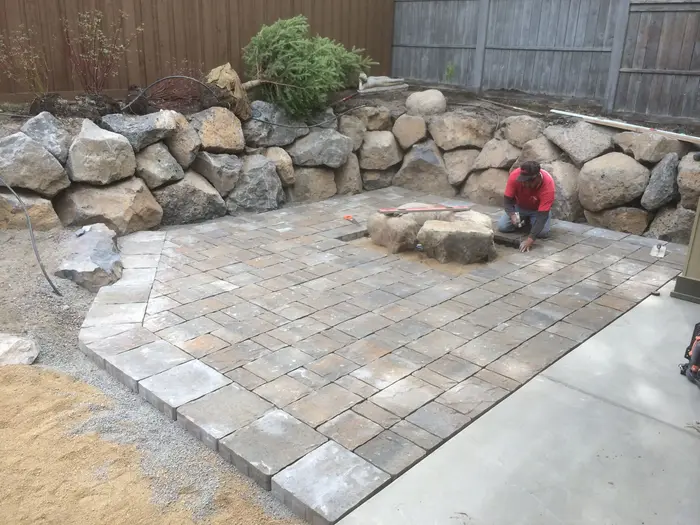
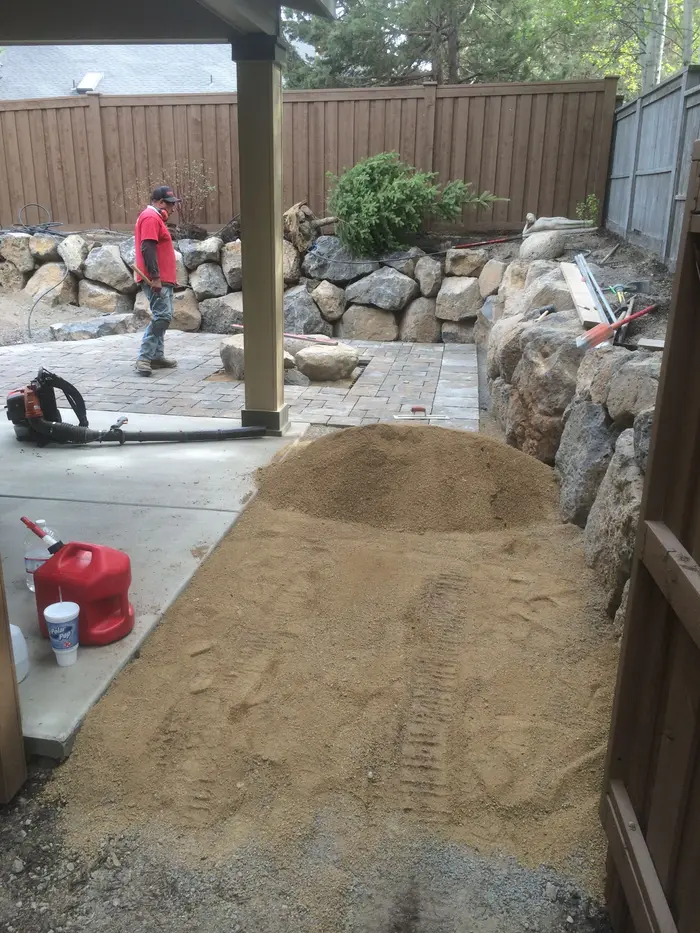
Base and bedding prep before the pavers go down. Photo: Newport Avenue Landscaping
Freeze-thaw and drainage in a high-desert yard
Pavers don’t crack the way slabs do, but water trapped in a poorly drained base freezes, lifts the pavers and leaves them uneven in spring. In Bend that can happen most nights for half the year.
Freezing nights in Bend, by month
Jan25
Feb24.2
Mar24.1
Apr19.4
May9
Jun1.9
Jul0
Aug0.3
Sep3.3
Oct13.9
Nov20.6
Dec26.2
Average nights at or below 32°F, about 168 a year. Green months average fewer than four. Source: NOAA NCEI 1991–2020 normals, Bend station USC00350694.
Slope the surface away from the house
Route downspouts away from the patio, not onto it
Keep sprinkler heads from spraying the pavers
Avoid low spots where snowmelt ponds and refreezes
Consider permeable pavers where runoff has nowhere to go
Plan where shoveled snow will be piled
Bend’s summer pour window that concrete crews chase matters less for pavers, but base material should not be compacted frozen or soaked. Late spring through early fall is the easy season.
Concrete pavers vs. natural stone
Concrete pavers
The most common and most consistent. Newport Avenue recommends pavers rated for ASTM C936, the freeze-thaw standard for concrete paving units. Dozens of colors and textures; choose a texture that isn’t slick with ice.
Brick-style pavers
Clay or concrete brick looks suit older Bend neighborhoods and craftsman homes. Ask whether the product is rated for severe freeze-thaw exposure.
Natural stone
Flagstone, basalt and slate fit the high-desert look. Set dry on gravel, flagstone flexes and drains; mortared on a slab, it can crack with freeze-thaw. Costs vary widely by stone.
Permeable pavers
Open joints filled with stone let water soak in instead of running off. Newport says they cost a bit more. In a City of Bend turf-rebate project, new impervious surfaces don’t qualify, but pervious paths such as ungrouted flagstone and gravel do count if the planting density is met.
A flagstone entry walk in Awbrey Glen. Photo: Newport Avenue Landscaping
Pavers vs. concrete
Pavers
Poured concrete
Freeze-thaw
Flex with the ground; joints absorb movement
Rigid; control joints make cracks straight
Repairs
Lift and reset or replace individual pieces
Patches rarely match
Up-front cost
Usually higher per sq ft
Usually lower for plain broom finish
Upkeep
Joint sand, weeds, occasional resetting
Sealing every few years
In the street right-of-way
Not allowed in Bend
Required for aprons where there’s a curb or sidewalk
The City of Bend requires a building permit for a retaining wall over 4 feet tall or one that supports an extra load from a building or other structure. The maximum is 6 feet unless approved through site plan review. Walls can sit on a property line but not in the right-of-way. More in our retaining walls guide.
Patios and driveways
At-grade patios generally don’t need a building permit. Decks and patios together may cover up to 15% of a lot’s required landscape area. Driveway approaches in the street right-of-way need a city permit and must be concrete where there’s a curb or sidewalk: no pavers in the right-of-way. Call 811 at least two business days before digging.
Pavers and the 0–5 foot zone
Zone 0 · 0–5 feet
Bend Fire & Rescue: remove mulch, leaves, needles and firewood from against walls and under decks, and use noncombustible ground cover such as pavers, crushed stone or mineral soil. The State Fire Marshal adds metal gates or fence sections where a fence meets the house.
Zone 1 · 5–30 feet
Fire-resistant plants, lawn mowed under 4 inches, debris raked, branches pruned back from the house. Keep firewood, lumber and propane tanks 30 feet out.
Zone 2 · 30–100 feet
Hardscape fuel breaks, fewer ladder fuels, trees limbed up (6 feet off the ground on trees taller than 18 feet).
A paver or gravel band against the foundation is one of the most effective fire upgrades for an existing Bend home, and it keeps snowmelt away from the foundation too.
What a paver estimate should include
Oregon has two contractor boards, and both matter in a yard. The Landscape Contractors Board says a company licensed with either the LCB or the Construction Contractors Board may build decks, patios, fences, retaining walls, walkways and water features. Planting, grading for landscaping, drainage and any irrigation work, including repairs and compressed-air blowouts, needs an LCB license. Look a company up on the CCB search or the LCB search and check that the name on the record matches your contract. Several companies here trade under an assumed business name, so the license holder’s name can differ from the sign on the truck.
Square footage and layout drawing
Excavation depth and spoils haul-off
Base material, depth and compaction method
Geotextile fabric, if used
Bedding material
Paver brand, line, color and thickness
Pattern and border
Edge restraint type
Joint sand or polymeric sand
Slope and drainage plan
Steps, walls, fire pit or seat walls
Irrigation and sprinkler changes
Permits and 811 locate
Cleanup, sealing (if any) and warranty
Maintenance after installation
Top up joint sand after the first season as it settles
Pull weeds early, before roots widen joints
Shovel with a plastic blade and ask snow crews to use a rubber edge or shoe
Use de-icer sparingly and rinse salty slush off in spring
Reset any paver that heaves after a hard winter
Keep needles and debris swept from the 0–5 foot zone
What pavers cost in Bend
Newport Avenue Landscaping is the one Bend hardscape company that publishes detailed prices; its pages give slightly different ranges, so both are shown. The 2025 Cost vs Value report adds a regional benchmark for a full backyard patio.
Base depthDriveways and soft pumice need more excavation and rock.
RockHitting basalt means breaking or working around it.
MaterialNatural stone and premium pavers cost more than standard concrete pavers.
Shape and patternCurves, borders and small units mean more cutting.
Walls and stepsGrade changes add walls, steps and drainage.
FeaturesFire pits, seat walls, lighting and kitchens.
AccessNo equipment access to the backyard means hand work.
Tear-outRemoving old concrete, lawn or bark.
Hiring checklist: questions to ask a Bend paver installer
License. What is your LCB or CCB number? Check it on the LCB search or CCB search.
Base. How deep will you excavate, what base will you use, how deep, and how will you compact it?
Pumice and rock. What changes if you hit soft pumice or basalt, and how is that priced?
Product. Which paver, and is it rated for freeze-thaw (ASTM C936 for concrete pavers)?
Edges. What edge restraint, and how is it anchored?
Drainage. Where will water go, including downspouts and sprinklers?
Walls. Will any wall be over 4 feet or hold up a driveway or building (permit needed)?
Fire. Can the 0–5 foot band around the house be pavers or gravel instead of bark?
811. Who calls in the utility locate?
Contract. A written contract with a drawing, product list and payment schedule.
Warranty. How long do you warranty settling and heaving, and what is excluded?
References. Can I see a patio you built three or more winters ago?
Paver FAQ
Do pavers crack in Bend winters?
Good pavers rarely crack; problems show up as heaving or settling when water sits in the base and freezes. Bend averages about 168 freezing nights a year (NOAA 1991–2020). A deep, well-drained, compacted base (Newport Avenue recommends 6–8 inches of crushed rock in pumice soils), solid edge restraint and freeze-thaw-rated pavers are what prevent it.
Should pavers be sealed?
It’s optional. Sealer can deepen color and help with stains and joint sand loss, but it needs reapplying and can make some surfaces slicker when icy. Ask your installer what they recommend for the specific product, and test a small area first.
Can pavers go over an existing concrete patio?
Sometimes, if the slab is sound, level and drains. Thin overlay pavers set on a bedding layer can work, but you raise the surface height at doors and steps, and a cracked or settled slab will telegraph through. Many installers prefer removing the old slab and building a proper base.
Are pavers good around a fire pit?
Yes. Pavers and stone are noncombustible and make a good fire-pit surround. Keep wood-burning pits well away from the house, fences, trees and decks, use a fire-rated insert, and check Bend Fire & Rescue’s current burn rules, which tighten in fire season.
How much does a paver patio cost in Bend?
Newport Avenue Landscaping posts $8,000–$16,000 for a basic 200–400 sq ft concrete paver patio, $16,000–$35,000 for 400–800 sq ft with a fire pit and $35,000–$80,000+ for a full outdoor living space. The 2025 Cost vs Value report puts a larger backyard patio project at $48,922 in Medford, Oregon.
Do I need a permit for a paver patio in Bend?
An at-grade patio generally doesn’t need a building permit, but check zoning: decks and patios may cover up to 15% of a lot’s required landscape area. Retaining walls over 4 feet, or supporting a structure, need a permit, and pavers aren’t allowed in the street right-of-way.
Are pavers a good choice next to the house for wildfire?
Yes. Bend Fire & Rescue’s Own Your Zone program lists cement pavers and crushed stone as the noncombustible ground cover to use in the first five feet around a home, in place of bark mulch and plants.