Seven Central Oregon concrete contractors checked against state license records, plus what it takes for a driveway, patio or foundation to survive Bend’s freeze-thaw winters: mix, base, joints, timing, permits, sealing and the questions to ask before you sign.
By All Things Bend · Updated October 23, 2026
7local contractors, each matched to an active Oregon CCB license
168nights a year at or below 32°F in Bend, on average (NOAA)
6–7%entrained air NRMCA recommends for slabs that will see de-icers
Jun–Septhe months with almost no freezing nights: the easy pour window
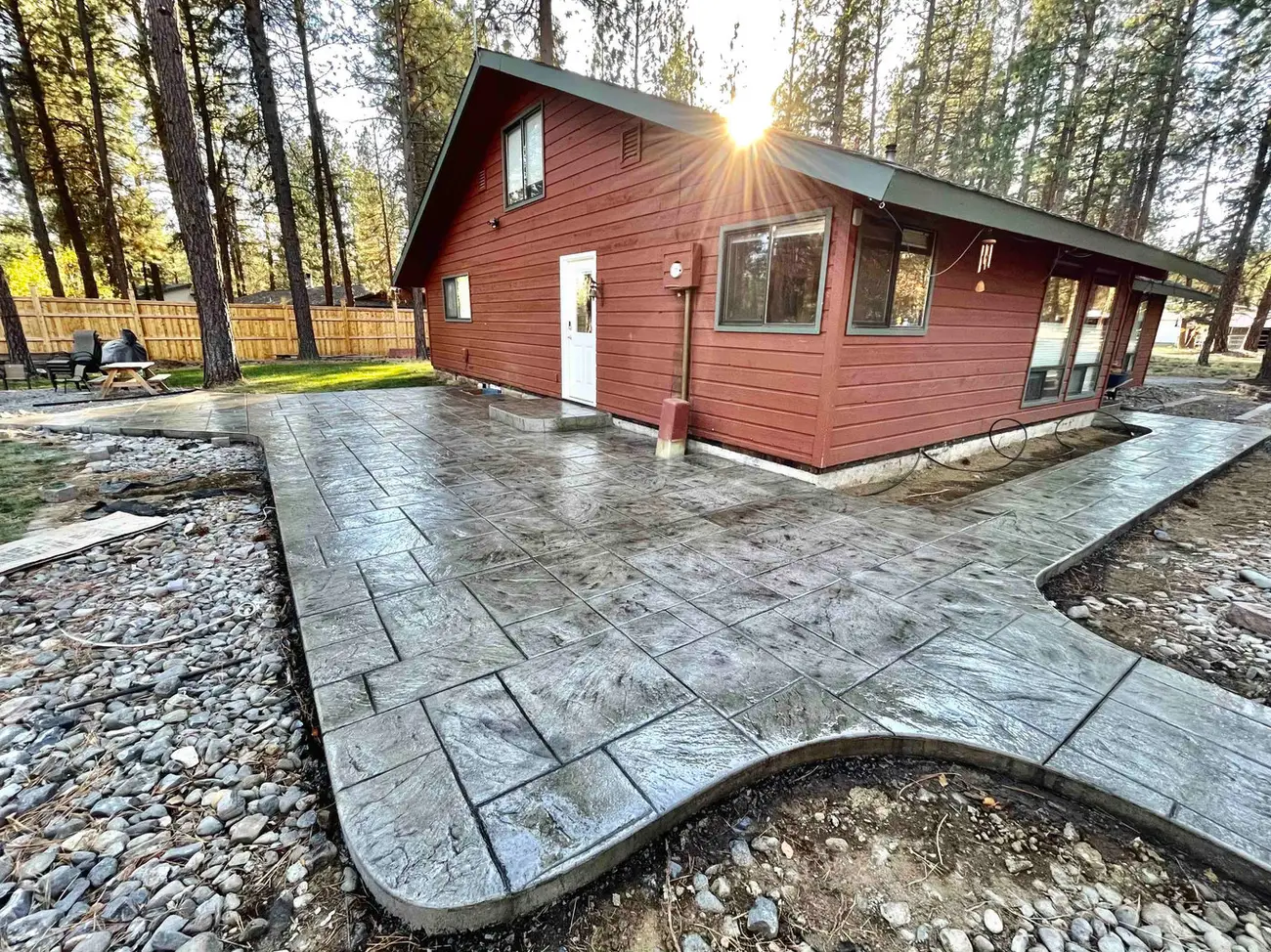
A stamped patio in Sisters. Photo: Endurance Concrete, used with credit.
Concrete looks simple once it’s finished, but most failures start before the truck shows up. In Bend a slab has to handle dry, hot summers and long winters where the temperature crosses freezing almost every day: January averages a 42.5°F high and a 24.6°F low. That makes the boring parts, the base, the air in the mix, the joints and the curing, matter more than the finish color. A good contractor can explain how the slab will be built, not just show you a stamp pattern.
Who to call for what
Tap your project to narrow the list below.
Tip: Ask for slab thickness, base depth, air content and a joint layout in writing.
Tip: See a finished job of the exact pattern and color, at least a year old if you can.
Tip: Usually part of a permitted build: get the engineer’s or builder’s specs to every bidder.
Tip: Over 4 feet, or holding up a driveway, slope or building? Bend wants a permit.
Tip: Only worth it if the slab underneath is sound. Settled or broken? Replace.
Listed in no particular order. Each was checked on its own website and matched to the state’s active-license data on October 23, 2026. Showing all 7.
Flatwork, driveways & slabs
Mountain Peak Concrete
Best for: Driveways, garage slabs and big flatwork, from a small pad to a commercial lot
A family-owned, third-generation concrete company run by Trevor Main. It says it has finished more than a thousand projects in the past 10 years, from 100 to 100,000+ square feet, and spells out its exterior mix: 4,000+ psi concrete with steel rod reinforcing. It also builds curbed garage slabs and sets brick paver borders in concrete.
Services
Driveway, patio, garage-slab and parking-lot removal and replacement; stamped concrete; sidewalks; new-home foundation slabs; concrete and asphalt removal; brick paver borders. Residential, commercial, industrial and agricultural flatwork.
Service area
Central Oregon (CCB address in Redmond)
Track record
CCB license since February 2018
Oregon license
CCB #218903, Residential General Contractor (Mountain Peak Concrete LLC), active through Feb. 23, 2028
Good to know
Asks for dimensions or square footage up front for a quick quote.
Best for: Foundations, shop slabs and retaining walls on a residential build
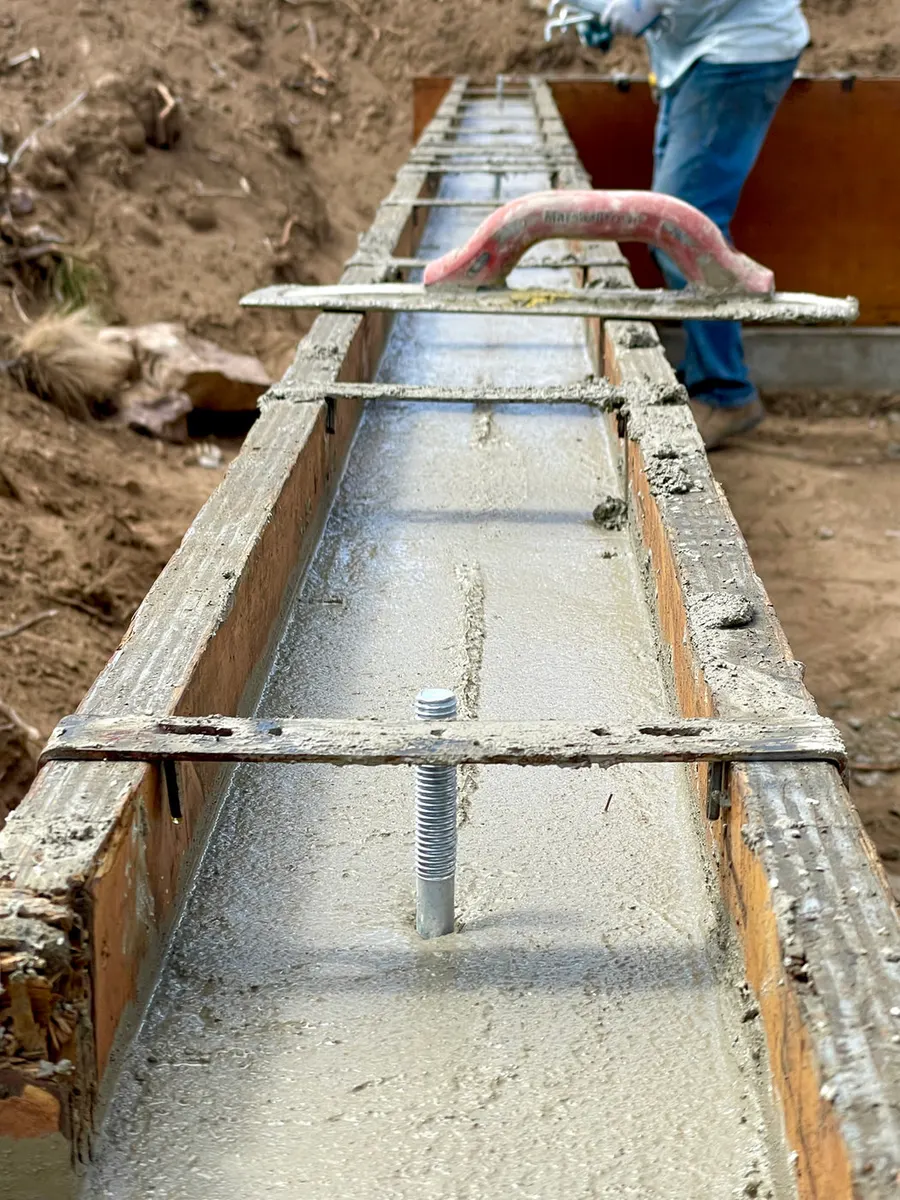
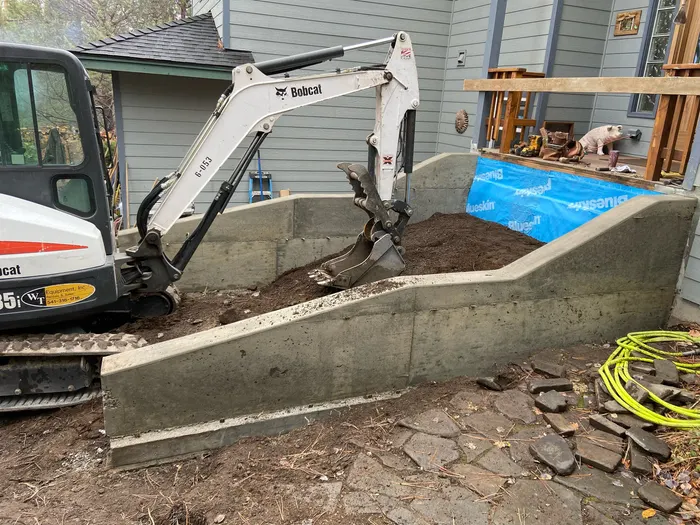
A Bend company founded in 2018 whose team brings more than 20 years of concrete experience. Its work is residential pours and finishes: footings and foundations, slabs for pole barns and shops, additions, driveways and stairways, patios with fire pits, and retaining walls.
Services
Driveways and stairways, foundations, patios and fire pits, pole barns and shops, additions and new construction, slabs, retaining walls.
Service area
Bend and Central Oregon
Track record
Established 2018; CCB license since May 2018
Oregon license
CCB #220443, Residential General Contractor (S & S Concrete LLC, Bend), active through May 1, 2028
A footing with its anchor bolt set. Photo: S&S ConcreteA poured retaining wall in progress. Photo: S&S Concrete
Residential flatwork & decorative
Fire & Ice Concrete
Best for: Residential flatwork with a decorative finish: stamped, acid-stained or exposed aggregate
Founded by Aaron Beaty, who has more than 20 years in concrete. The Bend company says it specializes in residential flatwork, and it is licensed, bonded and insured. Its gallery runs from front walks and stamped porches to house slabs and large commercial slabs.
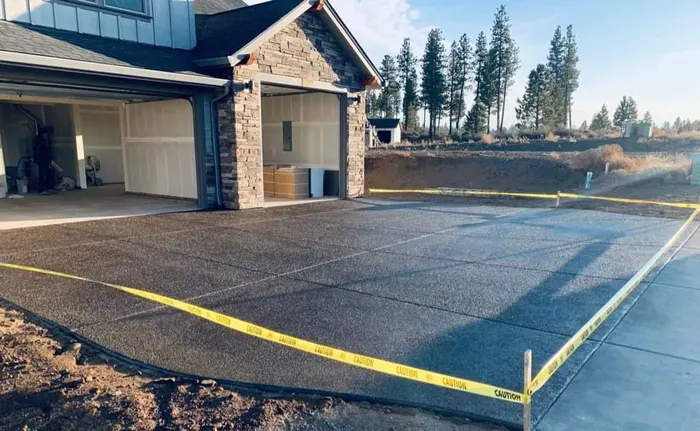
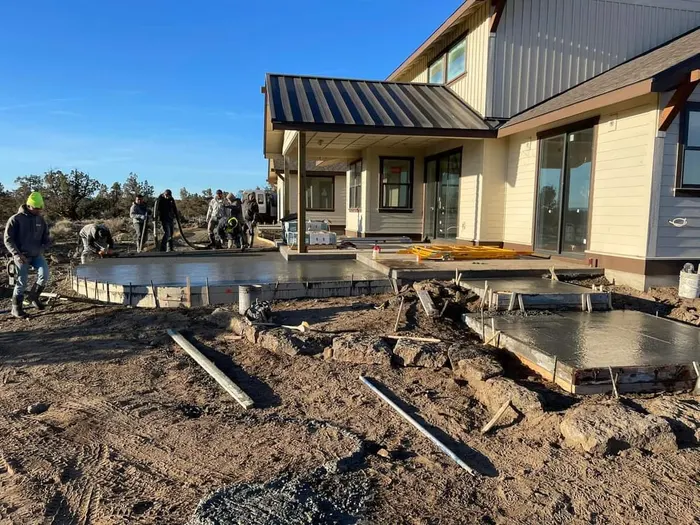
A new exposed-aggregate driveway, still taped off. Photo: Fire & Ice ConcreteFinishing a patio slab on a new build. Photo: Fire & Ice Concrete
Residential flatwork
Endurance Concrete
Best for: Patios, walks and driveways anywhere from La Pine to Madras
A family-owned and operated residential flatwork company with the tagline “Concrete Crafted for the Long Haul.” Besides new installs it hauls away old material and delivers. Its gallery includes a stamped patio in Sisters and plain broom-finish patios, walks and ramps around Central Oregon.
Services
Residential concrete flatwork installs; material removal and delivery.
Service area
Bend, Redmond, Sisters, Tumalo, Prineville, Black Butte, Terrebonne, Culver, Madras, Sunriver, La Pine “and beyond”
Track record
CCB license since March 2021
Oregon license
CCB #234768, Residential Specialty Contractor (Endurance Concrete Inc, Bend), active through March 15, 2027
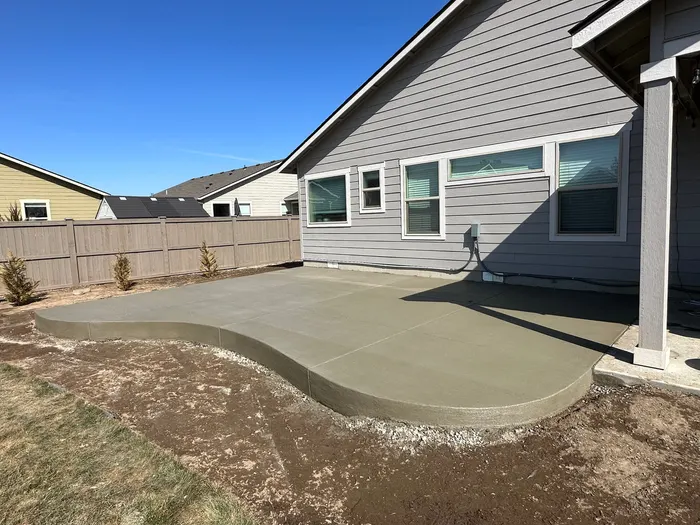
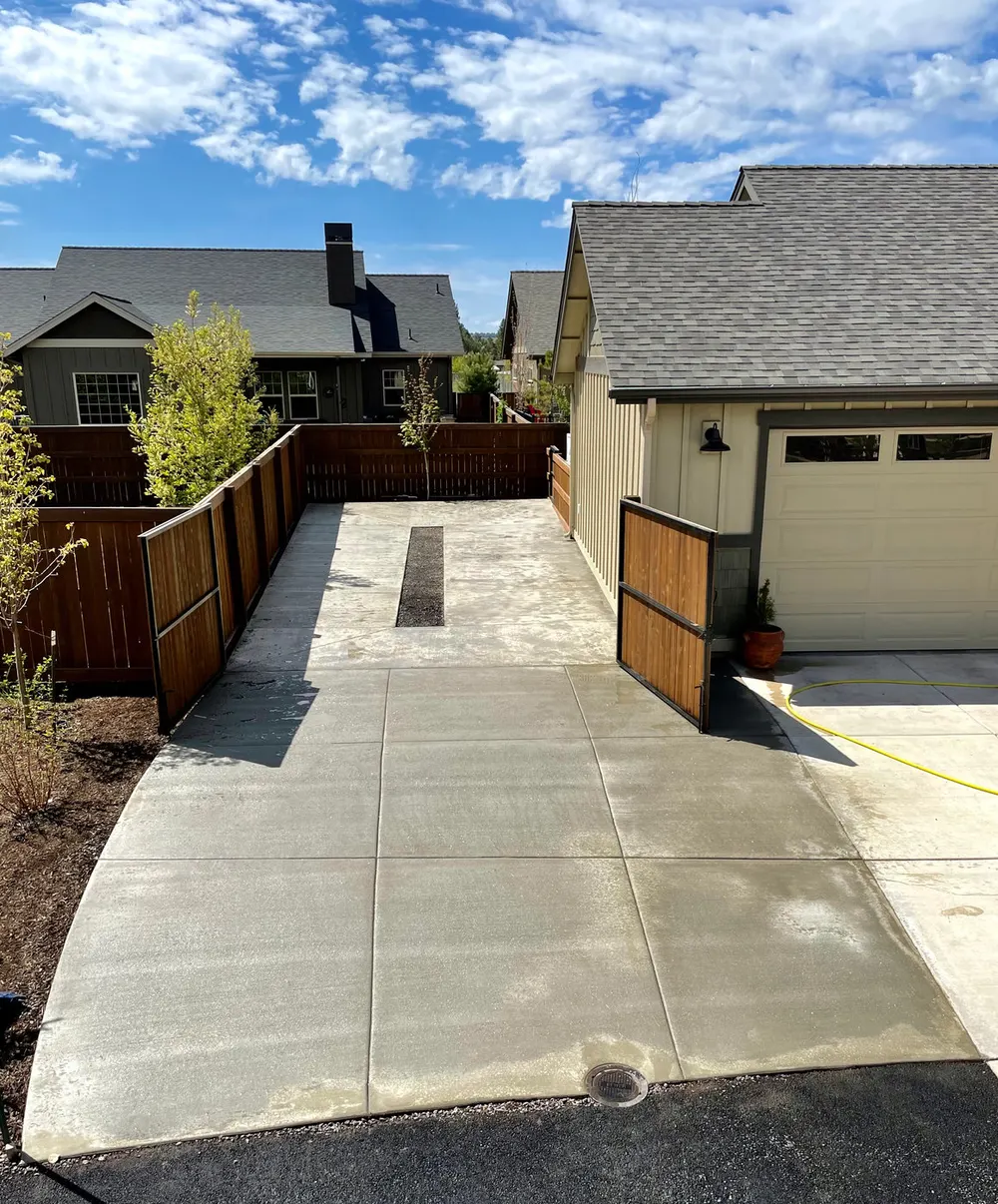
A new curved patio. Photo: Endurance ConcreteA side-yard drive with saw-cut joints. Photo: Endurance Concrete
Residential & commercial concrete
Kelly J. Witt Construction
Best for: One crew for almost anything concrete, including work from a builder’s blueprints
A Bend residential and commercial concrete contractor that works directly for homeowners and with general contractors on new construction, designing from existing blueprints. Its list is one of the broadest here, from decorative walks and retaining walls to curbing, tennis courts and parking lots. Free estimates.
Services
Decorative concrete, replacement and demolition, pea gravel, resurfacing, basement waterproofing, smooth and broom flatwork, driveways, pathways and patios, retaining walls, slabs, foundations, curbing, tennis courts, parking lots.
Service area
Bend, Sunriver, La Pine and Prineville
Track record
CCB license since December 2005
Oregon license
CCB #167052, Residential Specialty Contractor (Kelly J Witt Construction Inc, Bend), active through Dec. 2, 2027
Best for: Fixing, resurfacing or resealing an existing driveway, walk or patio instead of tearing it out
A family business in Bend since 2008 whose motto is “Don’t Repour… Restore.” It only works on exterior concrete and is one of the few local companies that publishes prices. It names ice melt and salt as the top cause of driveway damage it sees and recommends sealing every 2–4 years.
Services
Resurfacing (for pitted or spalled surfaces, with a two-layer color seal), color, tint and clear sealing, crack repair. Driveways, walkways, patios and porches only.
Service area
Bend, Redmond, Sisters, Sunriver, La Pine, Terrebonne, Madras, Powell Butte, Prineville (trip charge outside Bend and Redmond; photo estimates for La Pine, Prineville and north of Terrebonne)
Track record
Since 2008; CCB license since April 2008
Oregon license
CCB #181605, Residential Specialty Contractor (Superior Concrete Restorations LLC, Bend), active through April 17, 2028
Good to know
Published approximate prices: resurfacing $5.50/sq ft, color seal $3.25/sq ft, tint seal $2.00/sq ft, clear seal $1.75/sq ft, crack repair $3–$15 per linear foot. Resurfacing takes 4–5 days, sealing 2–4. Stay off 24 hours on foot and 72 hours with vehicles.
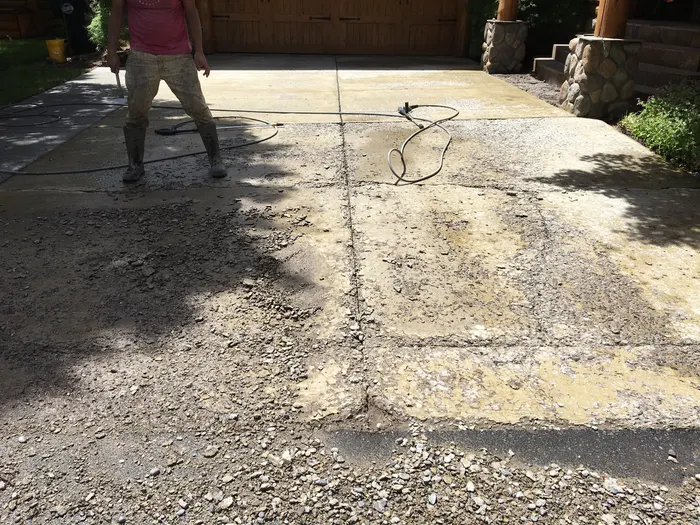
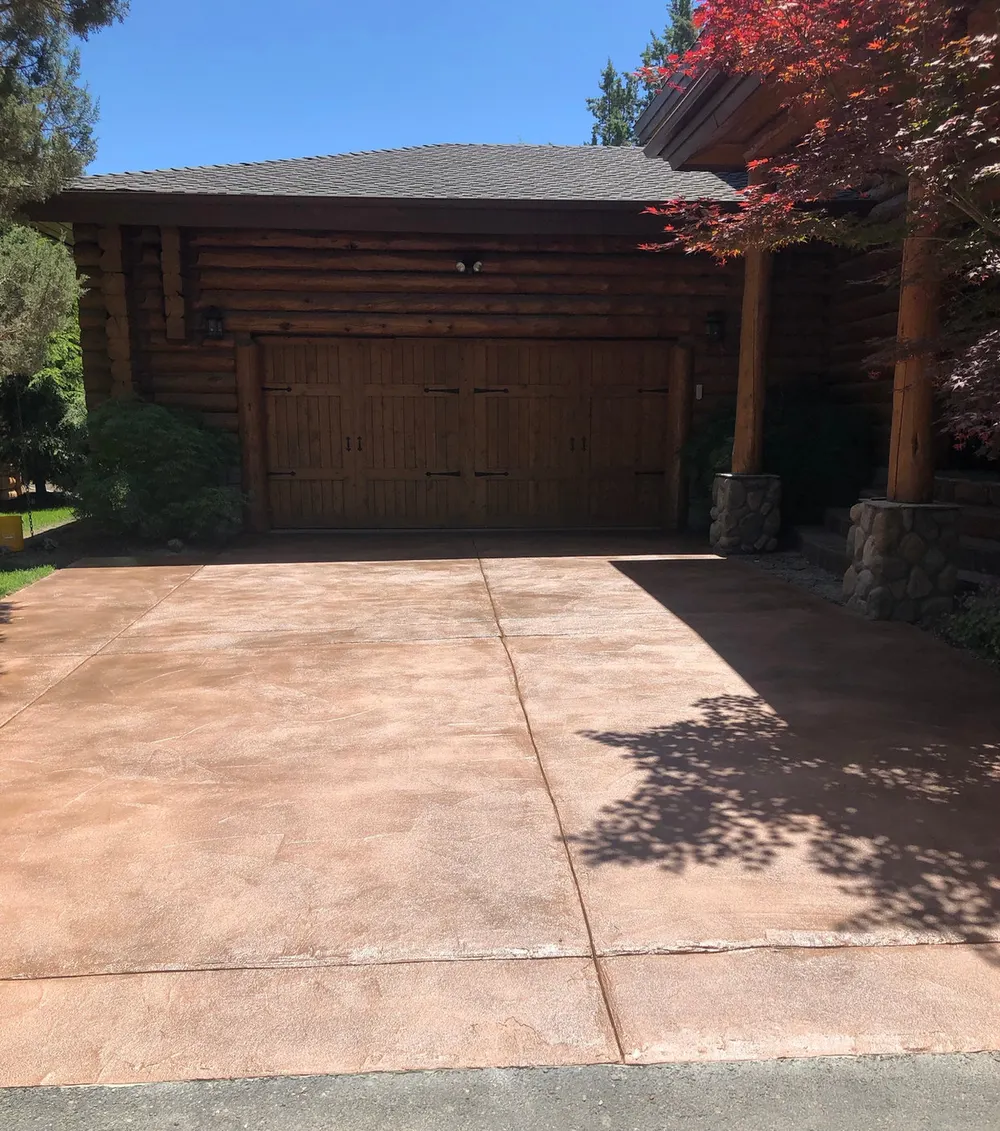
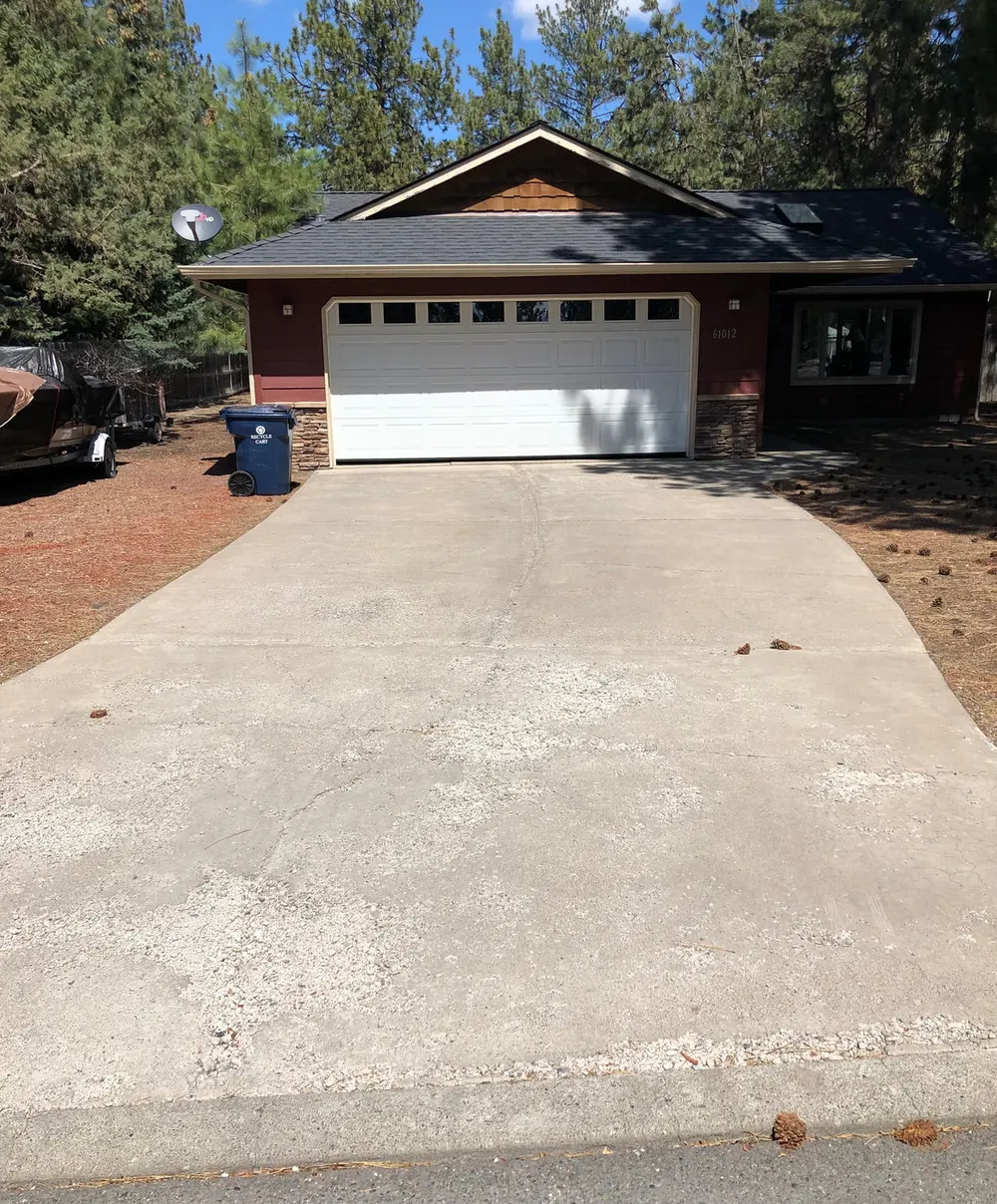
Prep on a worn driveway before resurfacing. Photo: Superior Concrete RestorationsA color-sealed driveway at a log home. Photo: Superior Concrete Restorations
General concrete
Steve Weeks Concrete
Best for: A long-licensed local name to add to your bid list; call for details
Steven Weeks’ company describes itself as “specializing in all phases of concrete construction throughout Central Oregon.” Its website is a one-page placeholder, so call or email to ask about the work it takes on and recent jobs you can see.
Services
All phases of concrete construction (no detailed list online).
Service area
Central Oregon
Track record
CCB license since April 2014
Oregon license
CCB #202599, Residential Specialty Contractor (Steve Weeks Concrete Inc, Bend), active through April 9, 2028
A patio, a driveway that carries trucks and a structural foundation don’t need the same slab. Here’s what to focus on for each.
Driveways
Vehicle loads, snow and de-icer make this the toughest residential slab. Get thickness, base, reinforcement and the joint plan in writing, and tell bidders about RVs, trailers or delivery trucks. Where your street has a curb or sidewalk, the City of Bend requires a concrete apron in the right-of-way. Driveway checklist.
Photo: Superior Concrete Restorations
Patios
Slope it away from the house, plan where downspouts and sprinklers will drain, and decide now about a hot-tub pad, fire pit or a future covered patio whose posts need footings. Curves look great but add joints.
Photo: Endurance Concrete
Foundations, shop and garage slabs
Structural concrete follows engineered or builder plans and a building permit, so the questions shift to schedule, inspections and who coordinates with your builder. S&S Concrete, Kelly J. Witt and Mountain Peak all list foundations or shop slabs.
Photo: Fire & Ice Concrete
Sidewalks, steps and other flatwork
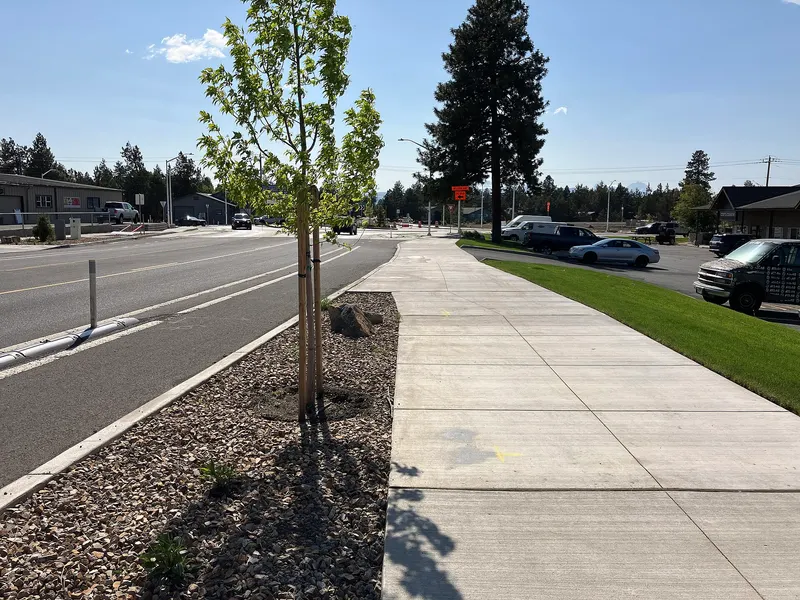
Walks, steps, landings, RV pads, hot-tub pads and shed slabs. If the sidewalk is the public one in front of your house, it sits in the city right-of-way: you’re responsible for keeping it in repair, and the fix needs a permit and a city-qualified contractor (see permits).
Stamped, stained, colored and exposed-aggregate finishes give a patio or walk a more finished look, but every decorative step adds a variable. Ask to see recent work in the exact finish you want, ideally a job that has been through a winter, and talk through:
Integral (mixed-in) color vs. surface-applied color
Release agent and antiquing
Sealer type, sheen and slip resistance when it’s icy
How often it needs resealing
Color variation between pours
How a repair will match later
Decorative concrete is still concrete: the base, air content and joints underneath matter just as much. Fire & Ice (stamped, acid-stained, exposed aggregate), Endurance, Kelly J. Witt and Mountain Peak all show decorative work.
The problem is surface pitting or flaking (spalling or scaling)
The overlay system suits the existing concrete
Replacement may make sense when:
Large sections have settled
Cracking is widespread and structural
The slope drains toward the house
Freeze-thaw damage goes deep
The base underneath has failed
NRMCA’s guidance is blunt: a repaired surface “will only be as strong as the base surface to which it is bonded,” so every weak or loose layer has to come off first. Don’t pay for a cosmetic coating to hide a structural problem. For a sense of repair pricing, Superior Concrete Restorations publishes approximate rates of $5.50 a square foot for resurfacing, $1.75–$3.25 for sealing and $3–$15 a linear foot for crack repair.
Built for Bend: what decides whether concrete lasts
Freezing nights in Bend, by month
Average number of nights at or below 32°F, NOAA 1991–2020 normals. About 168 a year.
Jan25
Feb24.2
Mar24.1
Apr19.4
May9
Jun1.9
Jul0
Aug0.3
Sep3.3
Oct13.9
Nov20.6
Dec26.2
Green months average fewer than four freezing nights. Source: NOAA NCEI, Bend station USC00350694.
Water that soaks into concrete expands when it freezes. Repeat that a hundred-plus nights a year, add snowmelt and de-icer, and weak surfaces flake off. NRMCA calls this scaling and lists four main causes: too little entrained air, too much salt on weak or poorly cured concrete, finishing while bleed water is on the surface, and not enough curing. Each of the items below is something to ask about.
Air-entrained mix
Air entrainment puts microscopic bubbles in the concrete that give freezing water room to expand. NRMCA says concrete exposed to freeze-thaw “must be air-entrained,” recommends 6–7% air for severe exposure (where de-icers are used) and 4–6% where they aren’t, and suggests about 4,000 psi strength when de-icers will be used. Ask what air content and strength the ready-mix ticket will show.
Subgrade and base
Concrete needs firm, even support. Much of the Bend area’s surface soil formed in a roughly three-foot layer of pumice and ash from Mount Mazama’s eruption about 7,700 years ago, according to the U.S. Forest Service: light, porous and fast-draining. Ask what will be dug out, what compacted base goes back in and how deep, and what happens to the price if the crew hits rock.
Drainage
Slope the slab away from the house and avoid low spots where snowmelt or sprinkler water sits and refreezes. NRMCA notes that water or salty water standing on a surface “greatly increases” the severity of freeze-thaw exposure.
Thickness
Have the slab thickness written into the proposal. Driveways, walks and equipment pads may differ, and thickness also sets how far apart the joints can be.
Reinforcement
Rebar, welded wire or fiber, depending on the job. NRMCA is clear that wire mesh “will not prevent cracking”; it keeps cracks tight. Mountain Peak Concrete, for example, says it uses steel rod reinforcing on exterior work.
Control joints
NRMCA’s rules of thumb: joint spacing no more than 24–36 times the slab thickness (about 10 feet for a 4-inch slab, never over 15 feet), panels close to square (length no more than 1.5 times width), grooves at least a quarter of the thickness deep, and saw cuts within 4 to 12 hours of finishing. Ask for a joint layout sketch.
Curing
Concrete needs moisture to gain strength. Bend’s dry, windy summer air pulls it out fast, and NRMCA warns that drying while still plastic causes plastic-shrinkage cracks. Ask whether the crew will use a curing compound or covers, and follow their instructions on foot traffic, vehicles and sprinklers.
Finishing
NRMCA: never finish while bleed water is on the surface, don’t add water to make finishing easier, and avoid steel trowels on exterior slabs. These are the moves that leave a weak top layer that scales in its first winter.
The best time to pour concrete in Bend
Average Bend temperatures by month
Month
Avg. high
Avg. low
Freezing nights
For a pour
Jan
42.5°F
24.6°F
25
Cold-weather measures needed
Feb
45.7°F
24.3°F
24.2
Cold-weather measures needed
Mar
51.7°F
27.6°F
24.1
Cold-weather measures needed
Apr
57.7°F
30.5°F
19.4
Cold-weather measures needed
May
66.3°F
37°F
9
Watch the overnight forecast
Jun
73.7°F
42°F
1.9
Easy window
Jul
83.8°F
48.6°F
0
Easy window
Aug
83.3°F
47.8°F
0.3
Easy window
Sep
75.8°F
41.3°F
3.3
Easy window
Oct
63°F
33.7°F
13.9
Watch the overnight forecast
Nov
49.1°F
28.2°F
20.6
Cold-weather measures needed
Dec
41°F
23.3°F
26.2
Cold-weather measures needed
NOAA 1991–2020 normals for Bend. “Easy window” = fewer than four freezing nights in an average month.
Summer is the easy season. Late June through mid-September averages almost no freezing nights. A pour in late July or August also leaves time for the slab to cure and be sealed before winter; NRMCA calls late summer the ideal time for a sealer. The tradeoff is heat and wind: ask how the crew will keep the surface from drying too fast.
Spring and fall can work with a plan. May still averages nine freezing nights and October about 14. NRMCA defines cold weather as more than three days in a row averaging below 40°F, and says plastic concrete freezes at about 25°F, which can cut its potential strength by more than half. Concrete should stay protected from freezing until it reaches 500 psi, about two days at 50°F, and from repeated freeze-thaw until about 3,500 psi.
Winter pours are possible with heated mix water, accelerators and insulated blankets, but they cost more and leave little room for error. Before agreeing to a cold-weather pour, ask:
Is the ground frozen, or is there snow or ice in the forms? (NRMCA: it must be removed and contact surfaces above freezing.)
What are the forecast overnight lows for the next week?
Will blankets or other protection go on, and for how long?
Is the mix being adjusted (heated, accelerated)? Calcium chloride accelerator shouldn’t exceed 2% of cement weight, per NRMCA.
What would make you postpone?
Don’t push a pour just to hit a date.
Driveways: details to get in writing
For a new or replacement driveway, ask the proposal to spell out:
Demolition and disposal
Excavation
Base depth and compaction
Slab thickness
Reinforcement
Air content and strength of the mix
Control joint layout
Slope and drainage
Isolation joints at the garage, walks and steps
Sidewalk, curb or apron work and its permit
Finish texture
Curing method
When you can walk and drive on it
If it will carry an RV, trailer or heavy deliveries, say so before the slab is designed.
Exposed-aggregate driveway. Photo: Fire & Ice Concrete
Driveway approaches in the City of Bend
Any work on a curb, sidewalk, driveway approach or gutter in the public right-of-way needs a city right-of-way permit (Bend Municipal Code 3.40.005).
Where a sidewalk or curb exists or is planned, the apron must be concrete. Otherwise the city engineer may allow an asphalt approach to the pavement edge (Standard Drawing R-5F).
No pavers or heated aprons are allowed in the right-of-way.
Single-family approaches run 10 to 24 feet wide; the Bend Development Code sets how many a lot can have.
Outside city limits, Deschutes County requires a driveway access permit for a new, rebuilt or widened driveway.
The City of Bend requires a building permit for a retaining wall over 4 feet tall, or one that supports an extra load from a building or other structure. The maximum is 6 feet unless it’s approved through site plan review or a land division. Walls can sit on a property line but not in the right-of-way. More in our retaining walls guide.
Sidewalks in front of your house
Bend property owners are responsible for maintaining the sidewalk along their lot, and the city sends violation notices for panels that are heaving, lifting, cracking or sloping. Repairs need a right-of-way permit and a contractor on the city’s Qualified Right-of-Way Contractor list; check it before you hire.
Zoning, easements and historic districts
Even when no permit is needed, the city says to check your zoning first. Keep slabs and walls out of public utility easements (check your plat), and expect extra review in Bend’s historic districts and the Waterway Overlay Zone along the Deschutes and Tumalo Creek.
Call 811 before digging
Excavation for a slab or footing can hit gas, power or irrigation lines. Oregon’s Utility Notification Center takes free locate requests at 811 or online, for homeowners and contractors alike. Confirm who on the job is making the call.
Not sure whether your project needs a permit? Ask the contractor who will pull it, and check with the City of Bend Planning Division (planning@bendoregon.gov, 541-388-5580 ext. 3) or Deschutes County Community Development before work starts. If you’re buying a house with an older slab or wall that was never permitted, see our guide to unpermitted work.
Verify Oregon licensing
Look it up. Search the company or CCB number on the Oregon CCB license search. Confirm it’s active and the name matches the company on your contract.
Check bond and insurance. The record shows the surety bond and liability insurance on file and when they expire.
Get a written contract. The CCB says residential jobs over $2,000 require one; if a smaller job grows past $2,000, the contractor has five days to provide it.
Get the notices. On those jobs the contractor must give you the Consumer Protection Notice, the Notice of Procedure and the Information Notice to Owner About Construction Liens.
Know your right to cancel. Oregon gives owners a one-day right to cancel an initial residential construction contract, and three days for a home solicitation sale.
Right-of-way work? Also check the City of Bend’s qualified contractor list.
What drives the cost of a concrete job
Bend contractors rarely post per-square-foot prices for new work, so get two or three written bids on the same scope. These are the items that move the number:
Tear-out and disposalOld concrete or asphalt has to be broken, hauled and dumped.
Digging and baseHow much soil comes out, how much compacted rock goes back, and whether the crew hits rock.
Thickness and reinforcementA thicker, rebar-reinforced driveway uses more material and labor than a 4-inch walk.
Shape and jointsCurves, steps and odd angles add forms, cuts and time.
FinishBroom finish is the baseline; exposed aggregate, color, stamping and sealing add steps.
AccessIf the truck can’t reach the forms, a pump or wheelbarrows add cost.
SeasonCold-weather pours can add heated concrete, accelerators and blankets (NRMCA).
Permits and right-of-wayApproach or sidewalk permits, and a city-qualified contractor for that part.
TravelSome companies add trip charges outside Bend and Redmond.
The one set of published local numbers we found is for repair work: Superior Concrete Restorations lists approximate rates of $5.50/sq ft for resurfacing, $3.25 for a color seal, $2.00 for a tint seal, $1.75 for a clear seal and $3–$15 per linear foot of crack repair, and says prices vary by job.
What a concrete estimate should include
Demolition
Excavation
Base material and depth
Compaction
Concrete thickness
Mix strength and air content
Reinforcement
Joint layout
Forms
Finish
Color or stamping
Sealer
Drainage work
Pumping or special access
Disposal
Who gets permits
Cleanup
Curing instructions
Warranty
CCB number
Questions to ask a Bend concrete contractor
What caused the damage on my existing slab, and will the new one fix that cause?
How much excavation and base prep is included, and how deep?
What thickness are you proposing, and why?
What air content and strength will the concrete have?
What reinforcement will you use?
Can you sketch where the control and isolation joints go?
How will the slab drain, and where does the water go?
What weather would make you postpone the pour?
How will you cure and protect it?
When can we walk on it, drive on it and use de-icer?
Who handles permits and the 811 locate?
What’s your CCB number, and can I see your insurance certificate?
What does your workmanship warranty cover, and for how long?
Can I see a job you did two or three winters ago?
Red flags
No CCB number on the bid, or a number that doesn’t match the company name
No written contract on a job over $2,000
“We had leftover concrete from a job nearby” door-to-door offers
A big cash deposit before any work is scheduled
A promise that the slab will never crack
No answer on base depth, joints or air content
Pouring on frozen ground or with a hard freeze forecast and no protection plan
Adding water at the site to make it easier to finish
A cosmetic coating offered for a slab that has settled or broken
Sidewalk or approach work in the street right-of-way without a permit
Caring for concrete through a Bend winter
No de-icers the first year. NRMCA says don’t use deicing salts such as calcium or sodium chloride in the first year after placing concrete. Use clean sand for traction.
Never use fertilizer as ice melt. Ammonium sulfate and ammonium nitrate are “chemically aggressive and destroy concrete surfaces,” per NRMCA.
After that, go easy. Shovel early, use salt sparingly, and hose off the salty slush cars drag onto new driveways and garage slabs when temperatures allow.
Seal before the freezes. NRMCA recommends a breathable silane or siloxane sealer and calls late summer the ideal time. Superior Concrete Restorations recommends resealing every 2–4 years; if water darkens the surface or soaks in, it’s time.
Keep water moving. Point downspouts and sprinklers away from slabs and fix low spots where meltwater ponds and refreezes.
Mind the plow. Ask your snow removal company to use a shoe or rubber edge on new or decorative concrete.
Clear your sidewalk. The City of Bend enforces rules about clearing snow and ice from sidewalks.
Concrete shrinks as it dries, and the National Ready Mixed Concrete Association says cracks “cannot be prevented entirely.” Control joints are planned cracks: they make the slab crack in a straight line inside a groove instead of randomly across the surface. Good base prep, reinforcement, joint spacing and curing keep cracking under control, but nobody honest promises a crack-free slab forever.
How long before I can drive on new concrete?
Follow your contractor’s instructions for your slab, because the mix, thickness and temperature all change the answer. Concrete keeps gaining strength for weeks, and it gains it more slowly in cold weather. For its resurfacing and sealing work, Superior Concrete Restorations tells customers to wait 24 hours before walking on it and 72 hours before driving or setting heavy items like a grill on it.
What is the best time of year to pour concrete in Bend?
Late June through mid-September is the easy window. NOAA’s 1991–2020 normals for Bend average 1.9 freezing nights in June, none in July, 0.3 in August and 3.3 in September, against 9 in May and almost 14 in October. Contractors can pour in colder months with heated concrete, accelerators and insulated blankets, but expect more cost and more risk. A late-summer pour also leaves time to seal before the first freeze, which NRMCA calls the ideal timing.
Is concrete better than asphalt for a driveway?
Neither is better everywhere. Concrete is rigid, takes decorative finishes and doesn’t need sealcoating, but it’s harder to patch invisibly. Asphalt flexes and is easy to patch or resurface. One Bend detail: where your street has a curb or sidewalk, the city requires a concrete apron in the right-of-way even if the rest of the driveway is asphalt. Compare both with our Bend asphalt companies guide.
Should I seal concrete in Bend?
Usually yes for outdoor slabs that see snow. NRMCA’s scaling guide recommends a breathable silane or siloxane sealer to keep new concrete from soaking up water before freeze-thaw season, and calls late summer the ideal time. Superior Concrete Restorations recommends resealing every 2–4 years; its quick test is to pour water on the slab, and if it darkens or soaks in, it’s probably time.
What ice melt is safe for concrete?
For the first year, none: NRMCA says not to use deicing salts in the first year after placement and to use clean sand for traction instead. After that, use salt sparingly, and never use ammonium sulfate or ammonium nitrate, which are fertilizer ingredients NRMCA says destroy concrete surfaces. Shovel early so you need less melt, and hose salty slush off new garage slabs and driveways when you can.
Do I need a permit for a concrete driveway in Bend?
For anything in the public right-of-way, yes. Bend Municipal Code 3.40.005 requires a city right-of-way permit to remove, alter or build a curb, sidewalk, driveway approach or gutter, and sidewalk work must be done by a contractor on the city’s Qualified Right-of-Way list. Single-family approaches can be 10 to 24 feet wide under city standard drawing R-5F. Outside city limits, Deschutes County requires a driveway access permit to build a new driveway or rebuild or widen an existing one, plus a separate Road Department permit if pavement in the right-of-way has to be cut.
How do I check a concrete contractor’s license in Oregon?
Search the name or CCB number on the Oregon Construction Contractors Board’s license search. Check that the license is active, that the name matches the company on your contract, and what bond and insurance are on file. Every contractor on this page matched an active CCB license on October 23, 2026.
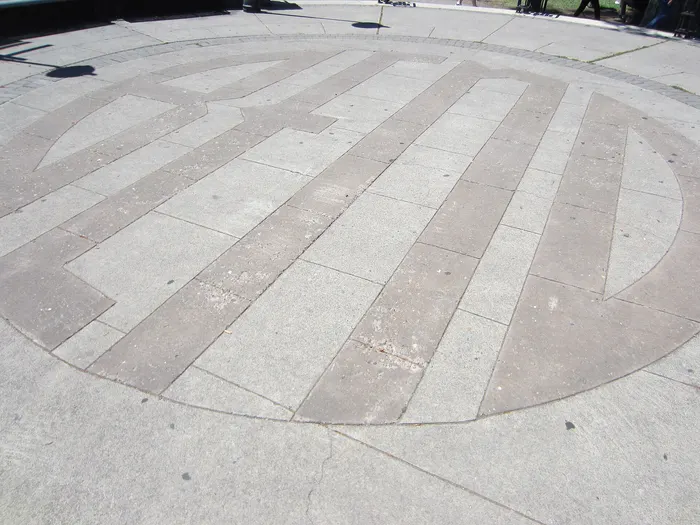
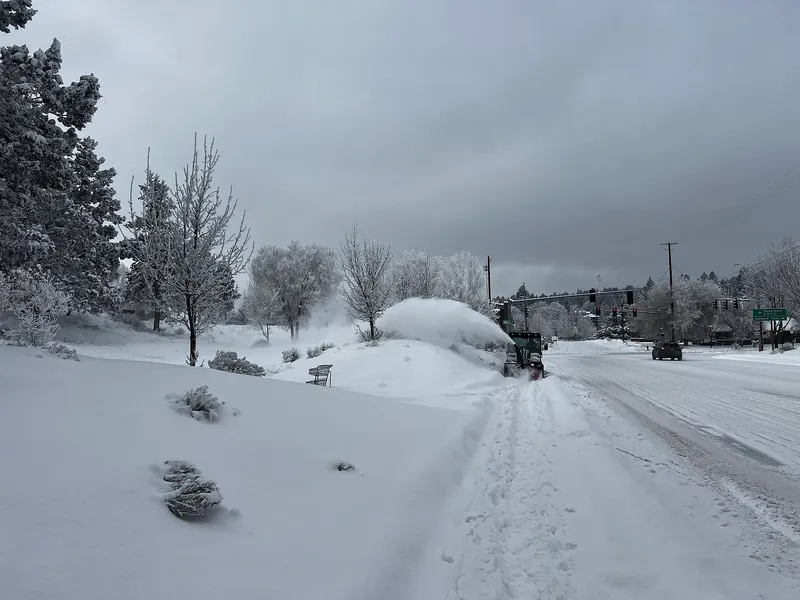
Photos: job photos by Endurance Concrete, Fire & Ice Concrete, S&S Concrete and Superior Concrete Restorations, from their websites, credited on each image. Bend sidewalk and snow-clearing photos by the Oregon Department of Transportation (CC BY 2.0); decorative paving by Another Believer (CC BY-SA 3.0), via Wikimedia Commons.
Know something we should add or update?All Things Bend is built to stay useful, not frozen in time.