Bend home guide · Room-by-room comfort · checked Oct. 23, 2026
Ductless Mini-Splits in Bend, Oregon
How to plan a mini-split for an ADU, garage studio, bonus room or baseboard house in Bend, what local installers charge and sell, where heads and outdoor units should go in snow country, and the rebates that still apply.
A wall head in an open living room won’t make a bedroom comfortable behind a closed door.
Map the rooms first, then compare single-zone and multi-zone designs.
Sketch the floor plan: which doors stay closed, which room overheats, which needs winter heat.
Decide where heads, line covers and the outdoor unit go before the quote is final.
For primary heat, ask for the model’s capacity at 5°F and the backup plan.
Check your utility’s rebate: most require replacing electric resistance heat.
What are you trying to heat or cool?
Pick the space.
Studio ADU: one zone is often enough
A single head in an open studio usually works if the loads say so. Ask where the head sits relative to the bed and how air reaches the bathroom. Central Electric Co-op’s rebate covers ADUs with electric resistance heat. Bend’s posted range for single-zone is $6,000–$9,000 (Bend Heating).
Bedrooms behind doors: plan a zone per space
Closed bedroom doors block a living-room head. Ask whether each bedroom gets its own head, or a compact ducted unit serves several rooms. Multi-zone systems in Bend run $7,500–$15,000 (Bend Heating’s posted range). The City permit covers one compressor and up to two heads for $36.68, plus $5.91 for each extra head, plus the base fee.
Bonus room over the garage
If the rest of the house is fine, a dedicated single-zone head is often simpler than reworking ducts. Ask about insulation and west-window sun first; see our insulation guide. For a room that’s only hot in summer, a cooling-focused head is smaller and cheaper than a year-round heating design.
Whole house on baseboards
Start with a head in the main living space (Energy Trust requires that for its $800 incentive), keep baseboards as backup, and add bedroom heads over time. Central Electric pays $700 replacing zonal heat; Midstate $920.
Garage, shop or studio
Tell installers how well the space is insulated and how often the big door opens. A converted garage needs its own permits and design; a mini-split isn’t the whole conversion plan. Rebates usually don’t apply to unconditioned garages.
Where mini-splits make sense in Bend
Bend’s ADU boom, garage conversions and older baseboard-heated homes make ductless one of the most common HVAC jobs in town. They shine where there are no ducts, where a room never got enough air from the central system, or where you want one space on its own schedule.
ADUs
Studio ADUs often need one head; one-bedroom ADUs usually need a second head or a compact ducted unit for the bedroom.
Additions and older homes
Compare wall heads with floor-mounted or concealed ducted options if you don’t like the look.
Bonus rooms and offices
Often cheaper than reworking ducts, if insulation and sun gain are handled too.
Baseboard and wall-heater homes
The biggest savings and the rebates are here.
Single-zone versus multi-zone: what are you actually buying?
A single-zone system is one outdoor unit and one indoor head. A multi-zone system runs several heads off one outdoor unit. Neither is automatically better.
Separate single-zone systems keep working if one fails, and each runs efficiently at low loads.
A multi-zone saves wall space outside but puts every room on one compressor.
Small bedrooms can be over-served by the smallest wall heads; a ducted “slim” unit can serve two or three rooms.
Be specific: “two heads” isn’t equal to “one head plus a concealed unit with short ducts to three bedrooms.” Roth works with five brands, and Diversified, AccuAir, Tri County and Deschutes Climate sell Mitsubishi, so you can compare lines.
Choose indoor-unit locations before installation day
Walk each location with the installer and ask:
Will air blow straight at a bed, desk or couch?
Is there room for curtains, furniture and filter cleaning?
Where does condensate go, and is a pump needed? (Pumps make noise and can fail.)
Where will the wall penetration and outside line-set cover show?
Can it be serviced without moving furniture or using a tall ladder?
Don’t like high wall heads? Ask about floor consoles, ceiling cassettes or concealed ducted units before the quote is final, and get the dimensions. In a new ADU or addition, set the routing while the walls are open. In a finished room, get patching, paint and anything the HVAC crew excludes in writing.
Winter heat and outdoor placement in Central Oregon
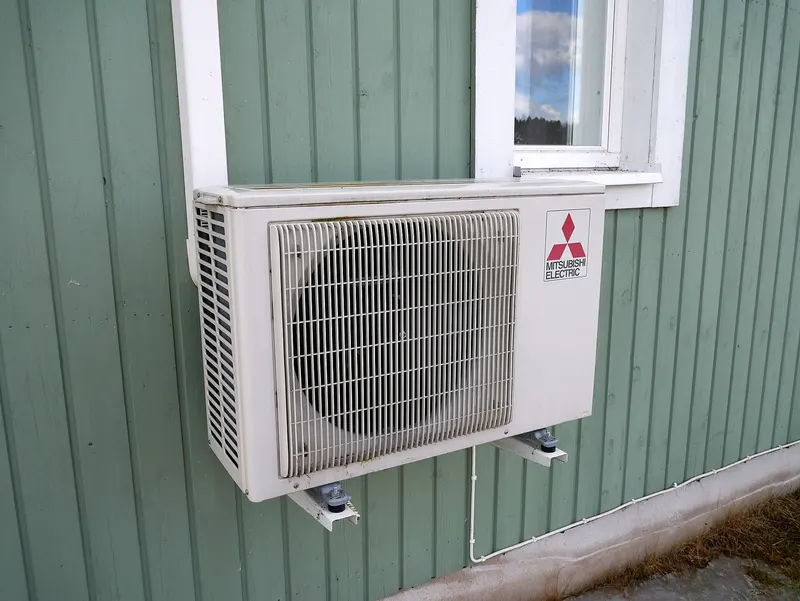
A wall bracket keeps the outdoor unit above snow. Mind bedroom windows and roof drip lines. Photo: Santeri Viinamäki (CC BY-SA 4.0).
If the mini-split is the space’s main heat, ask for the exact model’s output at 5°F and a backup plan: Bend averages about 9 nights a year below 10°F (NOAA). Cold-climate (“hyper heat”) lines from Mitsubishi and others hold capacity well below zero; a cooling-focused model for a summer office doesn’t need to.
Mount the outdoor unit on a bracket or stand above typical snow depth, out from under roof edges.
Plan where defrost water drains so it doesn’t freeze on steps or paths.
Keep it away from bedroom windows and the neighbor’s patio for sound.
Every company below lists ductless or mini-split installation on its own website, checked Oct. 23, 2026. Brands are what each site names. Ask each for the same floor plan and rooms so the quotes compare. Listed alphabetically, not ranked.
#179872 (AccuAir Inc, Redmond; active, licensed since 2007)
Heads up: Its banner says “Rebates up to $5,800 on qualifying systems.” Ask which programs that adds up, since state heat pump money for owner-occupied homes is used up (see rebates).
#1022 (Cascade Heating & Specialties Inc; active, licensed since 1972)
Heads up: Its install page still says “up to $2,000 in federal tax credits.” The federal 25C credit ended for equipment placed in service after Dec. 31, 2025.
Also checked on their own sites, with fewer details posted. Handy for a second or third quote, especially in Redmond, Sisters and Terrebonne.
Griffin Heating & Cooling (Bend) · 541-388-1472 Veteran-owned, in Central Oregon since 1985, 24/7 service. CCB 153261 (G5 Investments LLC) is due for renewal Oct. 24, 2026. Energy Trust trade ally.
Kinetic Mechanical Solutions (Bend) · 541-614-4060 24/7 emergency service, maintenance plans with 10% off invoices, ductless. CCB 257105 (licensed 2025). Energy Trust trade ally.
All Year Heating and Cooling (Redmond) · 541-588-4344 24/7 same-day service; furnaces, heat pumps, mini-splits, AC, gas fireplaces. CCB 248258. Energy Trust trade ally.
Seaton Heating & AC (Terrebonne) · 541-300-4435 Available 24/7, founded 2020. CCB 231375. Its site still advertises a federal tax credit that ended Dec. 31, 2025.
Action Air Heating & Cooling (Sisters) · 541-549-6464 American Standard, Daikin and Mitsubishi; Mon–Fri 8–5 with emergency service; service-agreement customers pay no trip charge. CCB 195556. Energy Trust trade ally.
Exact outdoor and indoor model numbers, and capacity at 5°F if it’s for heat
Number, style and location of every head, and which rooms each serves
Line-set length, route and exterior cover
Condensate route (gravity or pump)
Electrical work: new circuit, disconnect, panel space
Outdoor stand or wall bracket, and snow clearance
City of Bend mechanical permit ($36.68 per system up to two heads, $5.91 per extra head, plus the $93.73 base fee and 12% surcharge)
Wall patching and painting, or a note that it’s excluded
Warranty: Diversified posts 12 years parts and 5 years labor on Mitsubishi; ask everyone else
Which rebate they’ll file and deduct
Mini-split options compared
Single-zone
Multi-zone
Concealed ducted (slim)
Setup
One outdoor unit, one head
One outdoor unit, 2–5 heads
One indoor unit with short ducts to several rooms
Best for
Studio ADU, bonus room, office
Several rooms on one wall of equipment
Bedrooms where you don’t want visible heads
Posted Bend price
$6,000–$9,000
$7,500–$15,000
Not posted; ask
If it fails
Only that space is affected
Every connected room loses heat/cooling
All rooms it serves
City permit line
$36.68 per system
$36.68 + $5.91 per head over 2
Usually the HVAC system fee
What a mini-split costs in Bend
Only prices posted by Central Oregon companies or the City are shown, checked Oct. 23, 2026. Everything else is quote-only, so get two or three written quotes for the same scope.
about $146City of Bend permit, one system up to two heads ($93.73 base + $36.68 + 12% surcharge)City fee schedule
From $300/yrMaintenance membership that includes extra ductless headsDeschutes Climate
−$700 to −$1,500Central Electric Co-op ductless rebateRebates
−$800Energy Trust ductless incentive (Pacific Power, replacing electric resistance)Rebates
What moves the price
Number and type of heads. Each head adds equipment, line set and labor. Concealed and ceiling units cost more than wall heads.
Line-set length and route. Long runs through finished walls or two stories add labor and patching.
Cold-climate models. Hyper-heat units cost more but hold heat on Bend’s coldest nights.
Electrical. A dedicated 240V circuit and disconnect; panel space in older homes.
Condensate. A pump when gravity drainage isn’t possible.
Stand or bracket. Snow stands and wall brackets keep the outdoor unit clear.
Mini-split rebates (October 2026)
Nearly every ductless rebate in Central Oregon requires that the mini-split replace electric resistance heat (baseboards, wall heaters or an electric furnace). Mini-splits added to a gas-heated house, or only for cooling, generally don’t qualify.
Energy Trust of Oregon (Pacific Power customers)
Ductless heat pump replacing electric resistance heat
$800
Owner-occupied. HSPF2 8.10+; the largest indoor head goes in the main living space.
Oregon Dept. of Energy: Heat Pump Purchase Program
$2,000 through an approved contractor
$0 left for owner-occupied homes
Owner-occupied funding is fully reserved; about $2.5 million remained for rentals and $6.7 million for new construction on Oct. 1, 2026. HSPF2 8.1+ and SEER2 16+.
Home Energy Rebates (HEAR/HOMES) and the 25C tax credit
Not available now
Oregon has no launch date for HEAR/HOMES (contractor enrollment opened Oct. 12, 2026). The federal 25C credit ended for equipment placed in service after Dec. 31, 2025.
Mini-splits and smoke: plan air cleaning separately
Bend now averages several smoke days a summer at “Unhealthy for Sensitive Groups” or worse (Oregon DEQ). Mini-split heads recirculate room air through a light washable filter; they cool you during smoke season without opening windows, but they don’t clean the air much.
Add a portable HEPA purifier sized for the room, especially in bedrooms.
Clean the head filters more often in July–September.
If you need fresh air in a tight ADU, ask about an ERV or HRV with good filtration (Deschutes Climate and others list ventilation work).
Track conditions with Oregon DEQ’s air-quality advisories.
Bend’s climate and mini-splits
Mini-splits do well here because Bend’s cold is dry and sunny: 168 nights a year below freezing, but only about 2 below zero (NOAA 1991–2020). Summers are short: about 15.6 days a year reach 90°F, mostly in July and August, and nights cool into the 40s.
A head sized for winter heat is often oversized for cooling, which is fine; variable-speed compressors throttle down.
Rooms over garages and west-facing upstairs rooms are the classic Bend summer problem spots.
Snow and roof drip lines decide outdoor-unit placement more than looks.
Compare the alternative before choosing
Before committing, compare the mini-split with the other paths for your space:
Extend or fix the central ducts when the room is close to existing trunk lines and the system has capacity. Bend Heating & Sheet Metal fabricates duct parts.
A ducted heat pump if you’re replacing the whole house’s system anyway: see the heat pump guide.
Insulation and air sealing if a bonus room is hot because the attic above it isn’t insulated: see the insulation guide.
Repair if an existing central AC is simply underperforming: see the AC repair guide.
Questions to ask a mini-split installer
Which rooms will each head actually serve with the doors closed?
Single-zone, multi-zone or a concealed ducted unit: why that design for my floor plan?
What’s the heating capacity at 5°F, and what’s the backup heat?
Where will the line set, cover and outdoor unit go, and how high off the ground?
Gravity drain or condensate pump?
Does the price include the electrical circuit, permit and wall patching?
What brands do you install, and what are the parts and labor warranties?
Will you file my utility rebate and deduct it from the invoice?
How often should I clean the filters, and what does annual service include?
Ductless mini-splits in Bend: common questions
How much does a ductless mini-split cost in Bend?
Bend Heating & Sheet Metal posts $6,000–$9,000 for a single-zone system and $7,500–$15,000 for multi-zone, depending on the number of heads. Other Bend installers quote by job. The City of Bend permit for one system with up to two heads is about $146 including the base fee and state surcharge.
Are there rebates for mini-splits in Bend?
Yes, if the mini-split replaces electric resistance heat. As of Oct. 23, 2026: Energy Trust of Oregon pays $800 (Pacific Power customers, owner-occupied, HSPF2 8.10 or better, head in the main living space); Central Electric Co-op pays $1,500 replacing an electric furnace or $700 replacing baseboard or wall heat; Midstate Electric pays $920. Income-qualified households can get $1,800 through Energy Trust’s Savings Within Reach. State heat pump money for owner-occupied homes is used up.
Will a mini-split heat my ADU in a Bend winter?
A cold-climate model sized for the ADU can be its main heat. Bend averages about 9 nights a year below 10°F and 2 below zero. Ask for the model’s capacity at 5°F, and keep a small electric backup for the coldest nights or power-saving schedules.
Do I need a permit to install a mini-split in Bend?
Yes. The City of Bend fee schedule (FY 2026-27) lists a mini-split at $36.68 per system with up to two indoor heads, plus $5.91 for each additional head, on top of the $93.73 mechanical base fee and a 12% state surcharge. A new circuit also needs an electrical permit.
Single-zone or multi-zone?
Single-zone systems are simpler and keep other rooms running if one fails. Multi-zone systems serve several rooms from one outdoor unit. For small bedrooms, a concealed ducted unit serving two or three rooms is often better than a wall head in each. Ask each installer to explain their design for your floor plan.
Which brands do Bend installers use for mini-splits?
On their own websites: Mitsubishi (Diversified, AccuAir, Tri County, Deschutes Climate, Bend Heating, Roth), Daikin (Home Heating & Cooling, Bend Heating, Roth), Carrier (Pyramid, Bend Heating), and Fujitsu, LG and Bryant (Roth).
Do mini-splits help with wildfire smoke?
They let you keep windows closed and stay cool, but their washable filters don’t remove much fine smoke. Pair them with a portable HEPA purifier in bedrooms and clean the filters more often in smoke season.
Company details come from each company’s own website (linked on its card) and the Oregon CCB license data, checked Oct. 23, 2026. Indoor head: ArnoldReinhold, CC BY-SA 4.0. Outdoor unit: Santeri Viinamäki, CC BY-SA 4.0. Both via Wikimedia Commons.