Bend home guide · Heat pump decisions · checked Oct. 23, 2026
Heat Pumps in Bend, Oregon
Whether a heat pump will keep your house warm on a 5°F January night, which setup fits your home, which Bend installers sell which brands, and exactly which rebates are still open this fall (several big ones aren’t).
$1,000Energy Trust: ducted heat pump replacing an electric furnace
$1,500Central Electric Co-op: ductless replacing an electric furnace
$0state HP3 money left for owner-occupied homes
By All Things Bend · Updated Oct. 23, 2026 · Every company checked on its own website
An air-source heat pump running in falling snow. Photo: PeterEastern (CC BY-SA 4.0).
! Heat pump not heating?
Steam or a “whoosh” from the outdoor unit in cold, damp weather is usually a normal defrost cycle. It should resume heating within about 10–15 minutes.
Thermostat: set to Heat (not Cool or Auto with the wrong setpoint). “Aux” or “Emergency heat” showing means backup heat is running.
Outdoor unit: keep snow off the top and away from the sides, and don’t chip ice off the coil. A solid block of ice that doesn’t clear needs a tech.
Breakers: heat pumps have an outdoor disconnect and indoor breakers. If one trips again, stop and call.
Smell gas? Get out first
Leave without flipping switches, then call 911 or Cascade Natural Gas from outside.
A good heat pump proposal for Bend says how much heat the system delivers at your coldest design temperature, what backup heat covers the rest, and which rebates you qualify for based on your utility.
Ask for the model’s heating capacity at 5°F, not just its SEER2/HSPF2 badge.
Know your utility: Pacific Power (Energy Trust), Central Electric or Midstate co-op rebates differ.
Separate the installed price from incentives; most are paid through the contractor.
Agree on the outdoor-unit spot, snow clearance and condensate drainage before signing.
Which heat pump setup fits your house?
Pick what you heat with now.
Electric furnace: a ducted heat pump is the big win
Replacing an electric furnace is where heat pumps save the most and where rebates are biggest: $1,000 from Energy Trust (Pacific Power), $1,000–$2,050 from Central Electric Co-op depending on equipment and duct sealing, or $1,250–$1,560 from Midstate. Ask for a cold-climate (extended capacity) model and a backup-heat lockout at 35°F or lower, which Energy Trust requires.
Baseboards: start with ductless
No ducts? A ductless mini-split in the main living area is the usual first step: $800 from Energy Trust, $700 from Central Electric, $920 from Midstate. Keep baseboards in bedrooms as backup or add heads later.
Gas furnace + want cooling: consider dual fuel
If your furnace is under about 10 years old, a heat pump can replace (or stand in for) an AC and use the furnace as backup on the coldest nights. There’s no Energy Trust heat pump incentive with gas backup, so compare that with a heat pump-only design. Home Heating & Cooling (Daikin) and Central Oregon Heating (Carrier, dual-fuel offer) both list dual-fuel setups.
Replacing an old heat pump
Today’s variable-speed and cold-climate models hold far more capacity below freezing than units from 10–15 years ago. Central Electric pays up to $1,250 (site-built, with duct sealing) and Midstate $600 for a variable-speed upgrade. New systems use R-454B or R-32 refrigerant; R-410A parts remain available only to service existing systems.
New construction or an ADU
Ducted or ductless both work; a single-zone ductless system often suits a small ADU. The state Heat Pump Purchase Program still had money for new construction ($2,000 per heat pump, about $6.7 million left on Oct. 1, 2026) and rentals, through an approved contractor.
Which heat pump setup fits your Bend house?
Central ducts, replacing furnace and AC
A ducted heat pump with an air handler. Ask what happens to the indoor equipment, whether ducts need changes and what backup heat is included.
Gas furnace you want to keep
A dual-fuel system adds a heat pump outdoors and keeps the furnace for the coldest hours. The proposal should say when each runs.
Baseboards, an ADU or a room without ducts
A ductless mini-split avoids building a duct network. Decide which rooms need their own heads first.
Equipment works but bedrooms don’t
Fix airflow and the house first. A heat pump won’t fix a disconnected duct or an uninsulated bonus room.
Cold-weather performance: ask for more than an efficiency badge
Bend averages about 9 nights a year below 10°F and 2 below zero. What matters is how much heat the specific model delivers on those nights, and what covers the gap.
Capacity at 5°F. ENERGY STAR’s cold-climate label requires a heat pump to keep at least 70% of its 47°F capacity at 5°F with a COP of at least 1.75. Ask for the number for the exact model and size quoted.
Extended capacity. Energy Trust’s $1,000 extended-capacity incentive requires a central ducted system meeting CEE Tier 1 Path A, as the home’s primary heat, with no gas backup.
Backup heat. Electric strips or a gas furnace. Energy Trust requires the electric backup lockout at 35°F or lower on its standard heat pump incentive, so the heat pump does the work above that.
Load calculation. The design should follow a room-by-room load calculation (Manual J), not the old furnace’s size. Midstate pays $800 extra on its cold-climate ducted incentive when the installer verifies sizing.
Defrost is normal: in damp cold, the outdoor coil ices and the unit reverses briefly to melt it, sending up steam. Deschutes Heating & Cooling writes plainly that a heat pump isn’t automatically the best choice for every Central Oregon home; a good installer will tell you when dual fuel or a furnace makes more sense.
Outdoor-unit placement matters in Bend
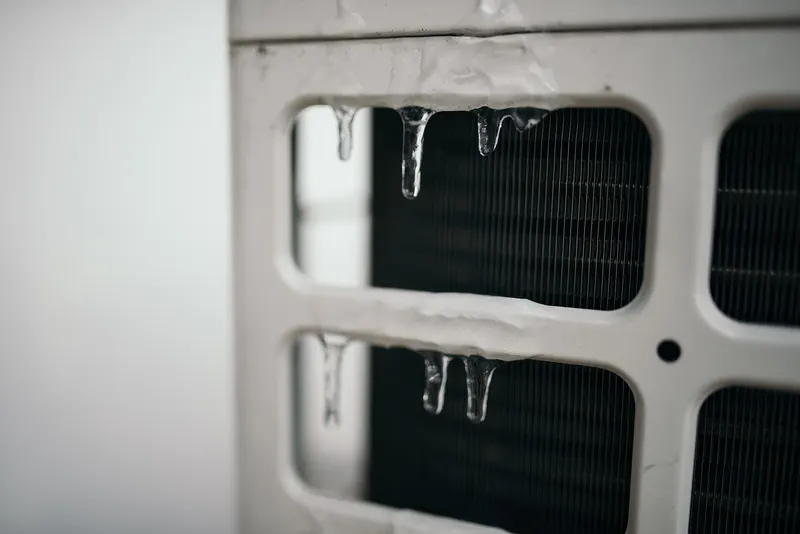
Ice and icicles on a heat pump grille. Raised stands and clear drainage keep defrost water from refreezing. Photo: Shixart1985 (CC BY 2.0).
Raise it. Ask for a stand or wall bracket that keeps the coil above typical snow depth, with the manufacturer’s clearances on every side.
Drainage. Defrost water has to drain and not refreeze on a walkway, steps or driveway.
Roof edges. Keep it out from under eaves that dump snow and ice.
Sound. Think about bedroom windows, decks and the neighbor’s side yard.
HOA rules. Many Bend subdivisions (and resort communities like Sunriver) regulate equipment placement and screening; check before the crew arrives.
Wildfire defensible space. Keep the area around the unit clear of bark mulch and juniper.
The electrical and ductwork questions
A heat pump usually needs a 240-volt circuit, and strip backup heat can add a large electrical load. The quote should say whether your panel was checked and who does the electrical work and permit. Central Oregon Heating and Roth have electricians in-house; otherwise see our Bend electricians guide.
For ducted systems, ask what will be tested or changed. A heat pump moves more air at lower supply temperatures than a furnace, so undersized or leaky ducts show up as drafts and weak heat. Central Electric’s ducted rebate for a site-built home is up to $850 higher when ducts are sealed and repaired.
Bend heat pump installers to compare
Every company below sells and installs heat pumps, per its own website, on Oct. 23, 2026. Brands are what each site names. All twelve show up as Energy Trust heat pump trade allies in Energy Trust’s contractor finder (Pyramid and Roth under their Portland-area offices). Listed alphabetically, not ranked.
#179872 (AccuAir Inc, Redmond; active, licensed since 2007)
Heads up: Its banner says “Rebates up to $5,800 on qualifying systems.” Ask which programs that adds up, since state heat pump money for owner-occupied homes is used up (see rebates).
#1022 (Cascade Heating & Specialties Inc; active, licensed since 1972)
Heads up: Its install page still says “up to $2,000 in federal tax credits.” The federal 25C credit ended for equipment placed in service after Dec. 31, 2025.
Also checked on their own sites, with fewer details posted. Handy for a second or third quote, especially in Redmond, Sisters and Terrebonne.
Griffin Heating & Cooling (Bend) · 541-388-1472 Veteran-owned, in Central Oregon since 1985, 24/7 service. CCB 153261 (G5 Investments LLC) is due for renewal Oct. 24, 2026. Energy Trust trade ally.
Kinetic Mechanical Solutions (Bend) · 541-614-4060 24/7 emergency service, maintenance plans with 10% off invoices, ductless. CCB 257105 (licensed 2025). Energy Trust trade ally.
All Year Heating and Cooling (Redmond) · 541-588-4344 24/7 same-day service; furnaces, heat pumps, mini-splits, AC, gas fireplaces. CCB 248258. Energy Trust trade ally.
Seaton Heating & AC (Terrebonne) · 541-300-4435 Available 24/7, founded 2020. CCB 231375. Its site still advertises a federal tax credit that ended Dec. 31, 2025.
Action Air Heating & Cooling (Sisters) · 541-549-6464 American Standard, Daikin and Mitsubishi; Mon–Fri 8–5 with emergency service; service-agreement customers pay no trip charge. CCB 195556. Energy Trust trade ally.
Outdoor unit + indoor air handler, uses your ducts
Outdoor unit + wall, floor or ceiling heads, no ducts
Heat pump + gas furnace sharing the ducts
Best Bend fit
Homes with an electric furnace or good ductwork
Baseboard homes, ADUs, additions, bonus rooms
Gas homes adding AC
Cold nights
Extended-capacity models plus electric backup
Cold-climate (“hyper heat”) models hold capacity well below zero
Furnace takes over below a set temperature
Energy Trust (Pacific Power)
$1,000 replacing an electric furnace or for extended capacity
$800 replacing electric resistance heat
No heat pump incentive with gas backup
Co-op rebates
CEC $1,000–$2,050; Midstate $600–$1,900
CEC $700–$1,500; Midstate $920
Ask your co-op
Bend brands (installers’ sites)
Trane, American Standard, Carrier, Lennox, Daikin
Mitsubishi, Daikin, Fujitsu, LG
Daikin, Carrier and others
Compare the complete installed proposal
Before choosing, make sure every quote answers the same questions:
Exact indoor and outdoor model numbers, and capacity at 5°F
What stays, what’s removed, and what backup heat is included
Electrical work, duct work and controls included
Outdoor-unit location, stand and drainage
Who pulls the City of Bend permit (or Deschutes County outside the city)
How startup and commissioning will be checked
Equipment and labor warranty (labor ranges from 1 year at Cascade and Deschutes to 5 years at Diversified)
Which incentives the contractor will apply for, and that they’re deducted on the invoice
What’s excluded
What a heat pump costs in Bend
Only prices posted by Central Oregon companies or the City are shown, checked Oct. 23, 2026. Everything else is quote-only, so get two or three written quotes for the same scope.
Under $200/moComplete systems financed (instant online price)Diversified
about $171City of Bend permit for a heat pump system ($93.73 + $59.09 + 12% surcharge); electrical permit extra if a circuit is addedCity fee schedule
−$1,000Energy Trust: ducted or extended-capacity heat pump (Pacific Power, owner-occupied)Rebates
−$1,000 to −$2,050Central Electric Co-op: ducted heat pump, site-built homeRebates
What moves the price
What you’re replacing. Swapping an old heat pump is simplest; converting from an electric furnace or adding to a gas furnace changes the indoor equipment and controls.
Cold-climate capacity. Variable-speed and extended-capacity models cost more and earn the bigger co-op rebates.
Electrical. A new 240V circuit, a panel upgrade or a new service can add significantly.
Ductwork. Sealing, resizing or adding returns. Central Electric pays more when ducts are sealed.
Backup heat. Electric strips vs. keeping a furnace (dual fuel).
Manufacturer promos. Lennox dealers (Tri County, Roth, Mountain View) have advertised manufacturer rebates; ask whether they apply to the model quoted and when they expire.
Check incentives before buying equipment
The first question is who sends your electric bill. Most of Bend is Pacific Power (Energy Trust incentives). Tumalo, Deschutes River Woods, Sisters, Redmond-area and other edges are often Central Electric Co-op; La Pine and Sunriver are often Midstate. Programs can’t always be stacked, and most are paid through your contractor.
Energy Trust of Oregon (Pacific Power customers)
Ducted heat pump replacing an electric furnace
$1,000
Owner-occupied single-family or manufactured home. HSPF2 7.5+; any backup heat must be electric with a lockout at 35°F or lower. Apply within 60 days; the installer signs.
Oregon Dept. of Energy: Heat Pump Purchase Program
$2,000 through an approved contractor
$0 left for owner-occupied homes
Owner-occupied funding is fully reserved; about $2.5 million remained for rentals and $6.7 million for new construction on Oct. 1, 2026. HSPF2 8.1+ and SEER2 16+.
Home Energy Rebates (HEAR/HOMES) and the 25C tax credit
Not available now
Oregon has no launch date for HEAR/HOMES (contractor enrollment opened Oct. 12, 2026). The federal 25C credit ended for equipment placed in service after Dec. 31, 2025.
Bend is a heating town: 6,561 heating degree days a year vs. 241 cooling degree days (NOAA 1991–2020). A heat pump’s efficiency matters most from November to April, not in July.
Cold but dry. About 168 nights a year dip below freezing, 41 below 20°F, 9 below 10°F and about 2 below zero. Low humidity means fewer heavy-frost defrost cycles than in wet climates, but snow piles up around outdoor units.
Big day-night swings. July averages 83.8°F by day and 48.6°F at night, so summer cooling loads are modest and opening windows at night often does a lot.
Elevation. At about 3,600 feet, a heat pump is unaffected by the thin-air burner issues of a gas furnace.
Smoke. A ducted heat pump with a MERV 13 filter (if the system can handle it) helps during smoke season; ductless heads only filter lightly.
Repair first, or plan a conversion?
If your furnace or AC works, you have time to plan: get two or three proposals in spring or early fall, line up rebate pre-approval (Central Electric requires it), and fix ducts and insulation first. If the furnace has just died in January, a like-for-like repair can buy time for a proper heat pump design later. Don’t let a no-heat emergency lock you into a system you’ll live with for 15 years.
Already have a heat pump that’s struggling? Common culprits are low refrigerant from a leak, a failing defrost board or sensor, a dirty coil or filter, or a system that was undersized from the start. See our AC repair guide for refrigerant questions; the same rules apply.
Questions to ask a heat pump installer
What’s this model’s heating capacity at 5°F, and is it ENERGY STAR cold-climate or CEE Tier 1 Path A?
Did you do a room-by-room load calculation? Can I see it?
What backup heat is included, and at what outdoor temperature will it lock out?
Which rebates do I qualify for with my utility, and will you deduct them on the invoice?
Are you an Energy Trust trade ally (or approved for my co-op’s program)?
Does the price include electrical work, a new circuit or panel, and the permits?
Where will the outdoor unit go, how high off the ground, and where does defrost water drain?
What refrigerant does it use (R-454B or R-32 on new equipment)?
What’s the labor warranty, and what maintenance keeps the manufacturer warranty valid?
Will you test duct leakage and static pressure?
Heat pumps in Bend: common questions
Do heat pumps work in Bend winters?
Yes, if you choose a cold-climate model and size it for your house. Bend averages about 9 nights a year below 10°F and about 2 below zero (NOAA 1991–2020). ENERGY STAR cold-climate heat pumps keep at least 70% of their capacity at 5°F. Ask for the exact model’s capacity at 5°F and what backup heat covers the coldest hours.
What heat pump rebates are available in Bend right now?
As of Oct. 23, 2026: Energy Trust of Oregon pays $1,000 for a ducted heat pump replacing an electric furnace or an extended-capacity heat pump, and $800 for a ductless unit replacing electric resistance heat (Pacific Power customers, owner-occupied). Central Electric Co-op pays $700–$2,050 and Midstate Electric $600–$1,900 depending on the system. Income-qualified households get more through Energy Trust’s Savings Within Reach. The state HP3 program has no money left for owner-occupied homes, the Central Oregon community heat pump grants are fully reserved, and the federal 25C credit has ended.
Is there still a federal tax credit for heat pumps?
No. The federal 25C Energy Efficient Home Improvement Credit ended for equipment placed in service after Dec. 31, 2025. Some installer websites still mention it; ask them to update the quote.
Should I replace my gas furnace with a heat pump?
If the furnace is old and you also want AC, price a heat pump or a dual-fuel system alongside a furnace-plus-AC replacement. If your furnace is young and works, a dual-fuel heat pump can replace just the AC. Energy Trust’s heat pump incentives in Oregon are for homes replacing electric heat, not gas, so the rebate math favors electric-heat homes.
How much does a heat pump cost in Bend?
Few Bend installers post prices. Bend Heating & Sheet Metal lists $6,000–$9,000 for a single-zone ductless system and $7,500–$15,000 for multi-zone. Ducted systems vary with the equipment, electrical and duct work, so get two or three written quotes for the same scope. The City of Bend mechanical permit for a residential system is about $171 including the state surcharge.
Why is my heat pump blowing steam or making a whooshing noise?
That’s usually the defrost cycle. In cold, damp weather the outdoor coil frosts over; the system reverses for a few minutes to melt it, releasing steam. If the unit stays encased in ice or never returns to heating, call for service.
Do I need a permit for a heat pump in Bend?
Yes. A heat pump is mechanical permit work in the City of Bend ($93.73 base plus $59.09 for a residential HVAC system, plus the 12% state surcharge on the FY 2026-27 schedule). New 240-volt wiring needs an electrical permit. Your contractor normally pulls both.
Which Bend HVAC companies are Energy Trust trade allies for heat pumps?
In Energy Trust’s contractor finder for ZIP 97702 (checked Oct. 23, 2026), trade allies include Bend Heating & Sheet Metal, Cascade Heating & Specialties, Deschutes Heating & Cooling, Deschutes Climate, Diversified Heating & Cooling, Home Heating & Cooling, Mountain View Heating, Tri County Climate Control, AccuAir and Central Oregon Heating & Cooling, among others. Trade allies know the paperwork, though you can use any licensed contractor.
Company details come from each company’s own website (linked on its card) and the Oregon CCB license data, checked Oct. 23, 2026. Heat pump in snow: PeterEastern, CC BY-SA 4.0. Defrost ice: Shixart1985, CC BY 2.0. Both via Wikimedia Commons.