Insulation in Bend, Oregon: Contractors, R-Values and Rebates
Bend gets about 168 freezing nights a year, plus summer smoke. Here are 9 Central Oregon insulation, air sealing and abatement companies checked on their own sites and against state licenses, the R-values to ask for, and the incentives that still pay in 2026.
By All Things Bend · Updated October 23, 2026 · Every license checked with the Oregon CCB
Phone, base and license for each company. “ET ally” means it appears in Energy Trust of Oregon’s trade-ally finder, which helps with incentive paperwork.
Full-service insulation shops first, then specialists for air sealing, crawl spaces, spray foam and asbestos. Services are as each company describes them. None of them post prices; all quote after a call or visit.
Insulation contractor · Bend
Energy Conservation Insulation (ECI)
The widest menu of materials from a Bend-based insulation shop, plus AeroBarrier air sealing.
Attic top-up
Spray foam
Crawl space & floors
Walls
Air sealing
Old insulation removal
Energy Trust ally
Locally managed Bend insulation company (part of SEI Group) that does new homes, remodels and existing-home retrofits. It installs batts, blown-in, BIBS, dense-pack cellulose, rock wool and both open- and closed-cell spray foam, and offers attic insulation removal and whole-home weatherization.
Long-running Bend branch of a national installer; strong for builders and larger projects, and it serves homeowners too.
Attic top-up
Spray foam
Walls
Air sealing
Energy Trust ally
The Bend branch of TruTeam (Builder Services Group) says it has insulated thousands of Central Oregon homes and commercial buildings. It installs everything from fiberglass batts to spray foam, plus air sealing, for homeowners, home builders and commercial contractors.
Diagnostic-first: energy audit, air sealing and insulation, then heat pumps if you want them.
Attic top-up
Crawl space & floors
Walls
Air sealing
Energy audit
Energy Trust ally
Locally owned B Corp with a Bend office that pairs building-science testing with the fix. It does air sealing, attic insulation, crawlspace and floor insulation, wall insulation and whole-home weatherization, often with blown cellulose, and also installs heat pumps, ERVs and heat pump water heaters.
HomeRx by Performance Insulation & Energy Services
Regional insulation company with a Redmond office and free online-booked assessments.
Attic top-up
Spray foam
Walls
Air sealing
Energy Trust ally
Sherwood-based Performance Insulation runs its HomeRx homeowner service from a Redmond office. It installs spray foam, blown-in and batts, hand air sealing and AeroBarrier, and offers energy services for code compliance.
Insulation and drywall from one crew, handy for remodels, garages and shops.
Attic top-up
Spray foam
Walls
Old insulation removal
Redmond company that installs blown-in fiberglass, unfaced and kraft-faced batts, BIBS, Rockwool and open- and closed-cell spray foam, and then hangs, tapes and textures the drywall. It lists insulation removal among its general construction services.
Bend’s AeroBarrier specialist for very tight new builds and gut remodels.
Air sealing
Energy Trust ally
AeroBarrier pressurizes the house with a blower door and fogs a waterborne acrylic sealant that settles into gaps from ½ inch down to hair-width, while the blower door reads the leakage live. The company says it can hit any IECC target and go below the Passive House 0.6 ACH50 level. It works best at rough-in or early drywall, though it can be used in finished spaces.
Crawl spaces with mold, wet soil, torn vapor barrier or fallen insulation.
Crawl space & floors
Attic top-up
Old insulation removal
Energy Trust ally
Bend restoration company that fixes the conditions around insulation: crawl space mold cleanup, 6-mil vapor barrier or 12-mil encapsulation, replacing fallen or missing insulation, re-hanging ducts, and attic ventilation (baffles, soffit and ridge vents, bath fan venting) with blown cellulose or fiberglass to R-49.
Spray foam for shops, ag buildings and homes, with a Bend phone line.
Spray foam
Spray foam company licensed out of Eugene that keeps a Bend line and says it works throughout Bend and Deschutes County. It does open- and closed-cell foam, roof insulation and hybrid foam-plus-batt systems for homes, shops, agricultural and commercial buildings.
Testing and removal when old insulation might contain asbestos, like vermiculite.
Old insulation removal
Despite the name, this Bend company (founded 1976) is now an asbestos abatement firm, with asbestos testing and surveys through an independent lab, mold restoration, lead renovation and mechanical (pipe, boiler and tank) insulation. Call it, not a regular insulation crew, if you find vermiculite or other suspect material.
Checked October 23, 2026 on: cascadeinsulation.com · license on the Oregon CCB register
Also licensed and working locally
Active Oregon CCB licenses with insulation work, but no website for us to check services against. Call and ask.
Elite Insulation LLC, Bend · 541-300-7847 · Energy Trust insulation trade ally, CCB 247383; no website
Cascade Foam Insulation LLC, Bend · 541-821-3392 · CCB 205462; no website found
DO Insulation LLC, Prineville · 541-280-1634 · CCB 203640; Energy Trust trade ally
Remarkable Remodel & Construction, Bend · 541-480-9266 · Energy Trust attic insulation trade ally, CCB 235246
Recommended R-values for Bend
Bend sits in climate zone 5. R-value measures resistance to heat flow; higher is better. Here’s what ENERGY STAR recommends, what Oregon code requires for new homes and for alterations to existing ones, and the level Energy Trust needs to pay its incentive.
Where
ENERGY STAR (zone 5)
Oregon code, new homes
Oregon code, existing homes
Energy Trust incentive
Attic (flat ceiling)
R-60 if uninsulated; R-49 if you have 3–4 in. now
R-49
R-49
Existing R-18 or less → R-38+ or fill the cavity
Vaulted ceiling
—
R-30 rafter / R-38 scissor truss
R-21 to R-25 (by rafter depth)
—
Above-grade walls
Blow empty cavities; add R-5 to R-10 sheathing when re-siding
R-21 (intermediate framing)
R-15
Existing R-4 or less → R-11+ or fill the cavity
Floor over crawl space
R-30
R-30
R-25 to R-30 (by joist depth)
Existing R-11 or less → R-30+ or fill
Crawl space or basement walls
R-15 sheathing or R-19 batt
R-15 continuous or R-21 cavity
—
—
Rim joists and knee walls
—
Part of the wall requirement
—
Rim R-15+; knee walls R-15 (2×4) or R-21 (2×6)
Attic (flat ceiling)
ENERGY STAR
R-60 if uninsulated; R-49 if you have 3–4 in. now
Code, new
R-49
Code, existing
R-49
Energy Trust
Existing R-18 or less → R-38+ or fill the cavity
Vaulted ceiling
ENERGY STAR
—
Code, new
R-30 rafter / R-38 scissor truss
Code, existing
R-21 to R-25 (by rafter depth)
Energy Trust
—
Above-grade walls
ENERGY STAR
Blow empty cavities; add R-5 to R-10 sheathing when re-siding
Code, new
R-21 (intermediate framing)
Code, existing
R-15
Energy Trust
Existing R-4 or less → R-11+ or fill the cavity
Floor over crawl space
ENERGY STAR
R-30
Code, new
R-30
Code, existing
R-25 to R-30 (by joist depth)
Energy Trust
Existing R-11 or less → R-30+ or fill
Crawl space or basement walls
ENERGY STAR
R-15 sheathing or R-19 batt
Code, new
R-15 continuous or R-21 cavity
Code, existing
—
Energy Trust
—
Rim joists and knee walls
ENERGY STAR
—
Code, new
Part of the wall requirement
Code, existing
—
Energy Trust
Rim R-15+; knee walls R-15 (2×4) or R-21 (2×6)
Quick attic check: measure the depth of your attic insulation. Under about 6 inches of fiberglass (roughly R-18) means you’re likely eligible for the Energy Trust attic incentive and well below the R-49 to R-60 target. Sources: ENERGY STAR · 2023 ORSC Tables N1101.1(1) and N1101.2 · Energy Trust
Insulation types compared
R per inch figures are typical ranges; check the bag or the installer’s spec sheet for the product you’re buying. The right choice depends more on where it’s going than on which material is “best.”
Blown (loose-fill) fiberglass
about R-2.2–2.9 per inch
Best for
Open attics, topping up old insulation
Why
Fast, inexpensive, doesn’t settle much, won’t burn. Every attic installer on this page offers it.
Watch out
Lower R per inch, so it needs more depth: roughly 20 inches or more for R-49 to R-60.
Blown cellulose
about R-3.2–3.8 per inch
Best for
Attics and dense-packing closed walls in older homes
Why
Recycled paper treated with borates; fills around wires and framing; dense-pack slows air movement.
Watch out
Heavier and settles some, so installers blow extra depth. Keep it dry.
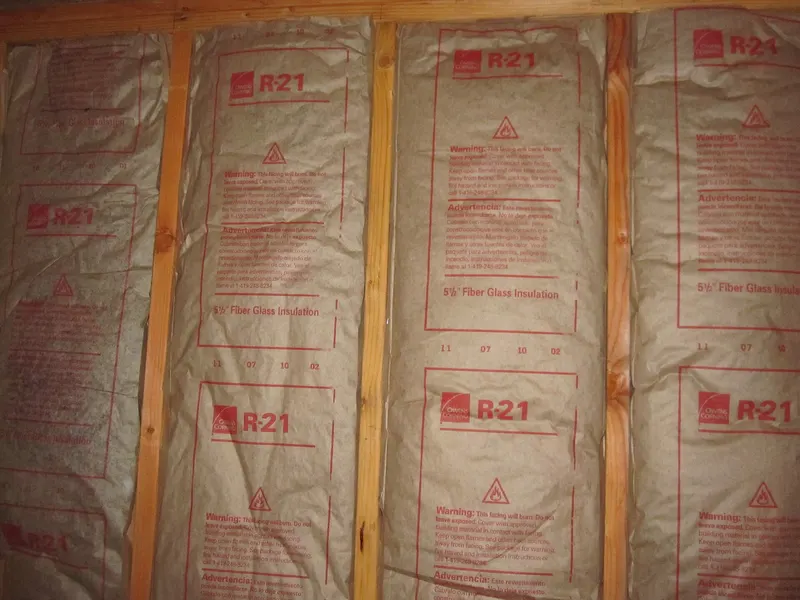
Faced R-21 fiberglass batts in a wall. Photo: PNNL / U.S. Department of Energy Building America (public domain).
Fiberglass or mineral wool batts
about R-3.0–4.3 per inch
Best for
Open framing in new builds, remodels, floors over crawl spaces
Why
Cheap, DIY-friendly, easy to inspect. Mineral wool (Rockwool) resists fire and water and holds its shape.
Watch out
Gaps, compression and sagging batts under floors kill performance. Must touch the subfloor.
BIBS / blow-in blanket
about R-4 per inch (varies by product)
Best for
New walls where you want better than batts
Why
Fiberglass blown behind netting fills irregular cavities with no gaps. ECI and Alpha 9 install it.
Watch out
Only for open framing; needs netting and an experienced crew.
Open-cell spray foam
about R-3.5–3.8 per inch
Best for
Roof lines, interior walls, sound control
Why
Expands to seal air leaks in one step; cheaper than closed-cell.
Watch out
Lets moisture through, so it needs a vapor strategy in cold climates. Professional install only.
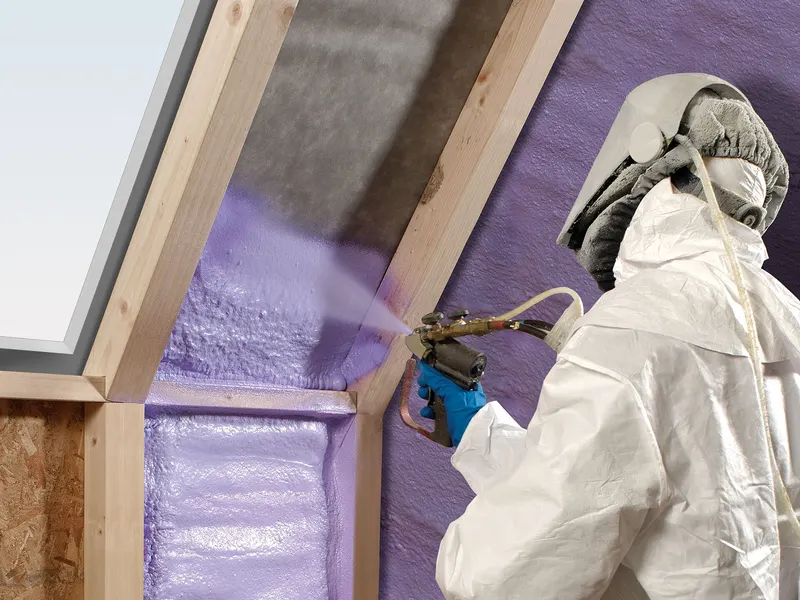
Spray foam going into wall framing. Photo: Cdpweb161, CC BY-SA 3.0, via Wikimedia Commons.
Closed-cell spray foam
about R-6–7 per inch
Best for
Rim joists, crawl space walls, shops, pole barns, tight spaces
Why
Highest R per inch, air and vapor barrier, adds rigidity.
Watch out
Most expensive per R. Foam must be covered with an ignition or thermal barrier in most spaces, and the house aired out after spraying.
Rigid foam board (EPS, XPS, polyiso)
about R-4–6.5 per inch
Best for
Crawl space walls, under new siding, attic hatches
Why
Continuous insulation that stops heat loss through studs. Easy DIY for hatches and rim joists.
Watch out
Seams need tape or foam; most foam board must be covered where it’s exposed inside.
AeroBarrier (air sealing, not insulation)
No R-value
Best for
New builds and gut remodels chasing a tight blower door number
Why
Seals hundreds of small leaks at once while you watch the leakage drop.
Watch out
Doesn’t replace insulation, and works best before finishes go in.
What’s different about insulating in Bend
Cold nights, snow on the roof, smoke season and crawl spaces shape what a good Bend insulation job looks like.
Long heating season
NOAA’s 1991–2020 normals for Bend average about 168 nights a year at or below freezing, with average December and January lows near 23–25°F. That is IECC climate zone 5B, the same row ENERGY STAR uses for its R-60 attic recommendation.
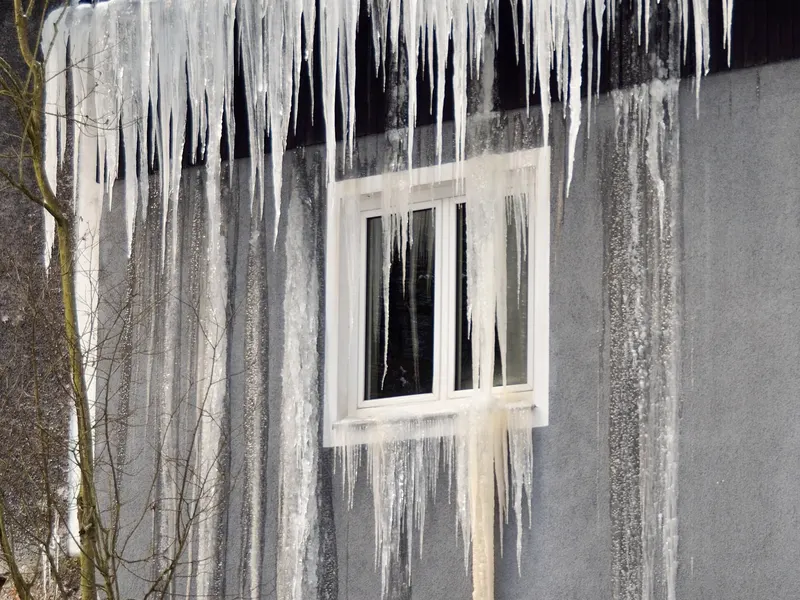
Warm air leaking into the attic melts roof snow, which refreezes at the cold eaves. DOE’s Building America guidance puts an airtight ceiling first, then thorough insulation, especially over the top plates, then roof venting. Heat cables treat the symptom.
EPA says outdoor air gets in through openings, joints and cracks, and recommends a MERV 13 filter (or the highest your system takes) during smoke events. Air sealing cuts those leaks. Ask your installer about fresh-air ventilation, like an ERV, once the house is tight.
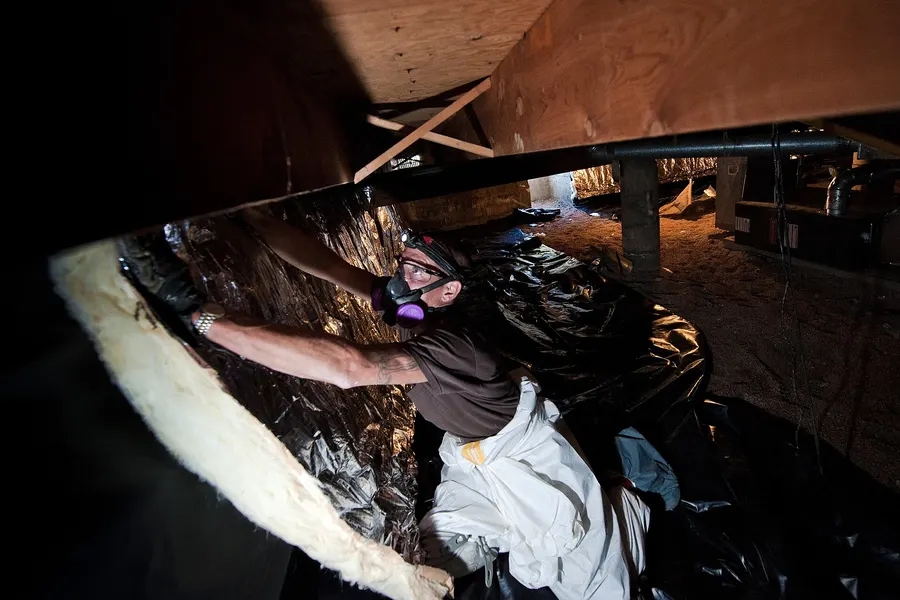
Many Bend homes sit over a vented crawl space. Floor insulation should be R-30 and touching the subfloor, the ground covered with a vapor barrier, and ducts off the dirt. Mice and voles love fallen batts, so pair insulation work with sealing entry points.
Older Bend homes may have thin attic insulation or none in the walls. Pebbly gray-brown loose fill can be vermiculite, which may contain asbestos. EPA: if in doubt, leave it alone and have it tested by an accredited professional before any work.
An ice dam: heat leaking from the house melts roof snow that refreezes at the eaves and backs up. Photo: Herzi Pinki, CC BY-SA 3.0, via Wikimedia Commons.Vapor barrier and insulation going into a crawl space during federal weatherization work (Colorado). Photo: U.S. Department of Energy (public domain).
Rebates and incentives in 2026
Which program you use depends on who heats your home. In Bend, Pacific Power and Cascade Natural Gas customers use Energy Trust of Oregon; Central Electric Cooperative members use CEC’s own rebates.
Energy Trust of Oregon
Home mainly heated by Pacific Power electricity or Cascade Natural Gas
Area
Owner, single-family
Rental or income-qualified
Attic
$1.25/sq ft
$1.50/sq ft
Wall
$1.50/sq ft
$2.25/sq ft
Floor
$0.75/sq ft
$1.00/sq ft
Attic: existing R-18 or less, insulate to R-38+. Walls: existing R-4 or less, insulate to R-11+ or fill. Floors: existing R-11 or less, insulate to R-30+.
Apply within 60 days of installation with the invoice, square footage and starting and ending R-value. The installing contractor signs; DIY is allowed with pre-approval (call 1-866-368-7878).
Duplexes to fourplexes and townhomes get higher owner rates ($1.50 attic, $2.25 wall, $1.00 floor).
NeighborImpact weatherization: air sealing, duct sealing, insulation, HVAC and safety work after a 3–4 hour energy audit, for renters and owners in Deschutes, Crook and Jefferson counties. Income limits from March 2026 start at $2,660/month for one person and $4,553 for three. Apply · 541-316-2034
CEC income-qualified: free to low-cost weatherization for members at or below 60% of state median income ($73,817 a year for a family of four). Details
Energy Trust Savings Within Reach: the higher income-qualified rates in the Energy Trust table.
Not available right now
Federal 25C tax credit: the 30% (up to $1,200 a year) insulation credit covered products installed through December 31, 2025. The July 2025 federal tax law ended it for later work. ENERGY STAR
Oregon HEAR/HOMES rebates: funded by the federal Inflation Reduction Act and meant to cover insulation and air sealing, but not open to homeowners as of October 2026. Contractor enrollment began October 12, 2026; no homeowner date yet. ODOE
Energy audits and Bend’s Home Energy Score
An audit tells you where the heat actually leaks before you spend on insulation. A Home Energy Score is a simpler rating, and in Bend it’s required to sell most houses.
Diagnostic energy audit
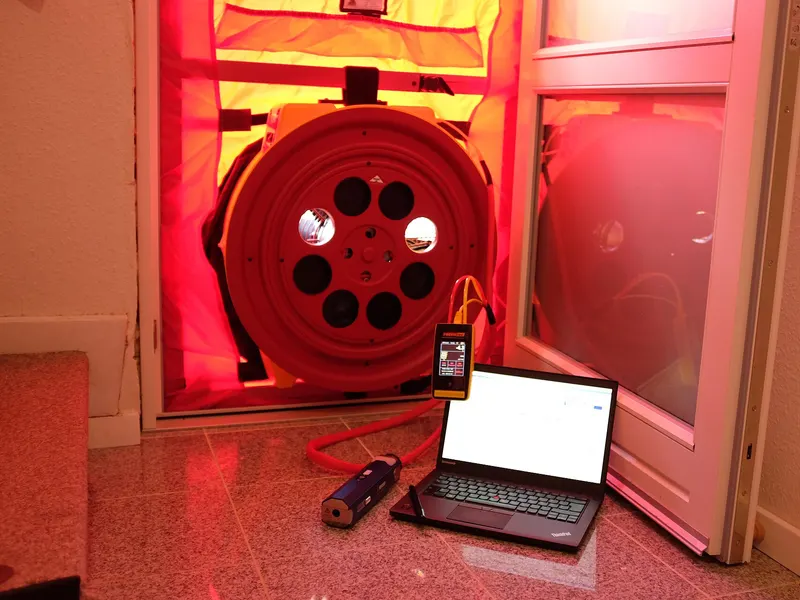
A blower door depressurizes the house to measure air leakage, often with an infrared camera to find cold spots. GreenSavers’ Bend audits can include blower door testing, infrared imaging, insulation and air-leak evaluation, an HVAC review and indoor air quality testing, with a prioritized report. NeighborImpact includes an audit for income-qualified households.
Since July 1, 2023, homes listed for sale inside Bend city limits need a Home Energy Score from a state-licensed assessor on the listing. It covers detached homes and side-by-side attached units, not stacked condos, and some sales are exempt. Bend assessor Get My Home Energy Score posts 2026 prices of $235 up to 1,500 sq ft, $250 for 1,501–2,500 and $280 for 2,501–3,000. The city covers scores for sellers under 80% of area median income.
A blower door set up for a test. The fan and gauge measure how leaky the house is. Photo: BoRohde, CC BY-SA 4.0, via Wikimedia Commons.
What insulation costs in Bend
None of the contractors we checked post prices online; every one quotes after a call or site visit. Get two or three written quotes that list the material, the starting and ending R-value and the square footage. That’s also what Energy Trust needs.
Material and depth. Blown fiberglass or cellulose in an open attic costs the least per R-value; closed-cell spray foam costs the most.
Prep work. Air sealing the ceiling, baffles at the eaves, an insulated hatch and moving can lights or bath fan ducts add labor but make the insulation work.
Removal. Rodent-soiled or wet insulation has to come out first. Suspected vermiculite needs testing and an abatement contractor.
Access. Low crawl spaces, tight attics and finished walls take longer than open framing.
Ventilation. A tighter house may need bath fan venting or fresh-air ventilation, which can mean a separate permit.
Incentive math example
A 1,500 sq ft attic with 4 inches of old fiberglass, topped up to R-49:
Energy Trust, owner-occupied
1,500 × $1.25 = $1,875
Energy Trust, rental or income-qualified
1,500 × $1.50 = $2,250
CEC member with air sealing
1,500 × $0.70 = $1,050
Posted prices we did find: a Bend Home Energy Score runs $235–$280 for homes up to 3,000 sq ft. Incentives can change; confirm before you sign.
Permits and code
Adding insulation
The 2021 Oregon Residential Specialty Code listed retrofitted insulation as permit-exempt; the 2023 edition’s exemption list no longer names it. Before a big retrofit, ask the City of Bend Building Division (Deschutes County outside city limits) whether your job needs a permit.
When work opens walls or adds space, Oregon’s energy chapter applies, and inspectors check insulation and vapor retarders before drywall goes up. For alterations, the existing-building table (R-49 attics, R-15 walls) applies as far as cavity depth allows.
Bend requires a permit to reroof, citing its wildfire hazard zone, and limits roofing to asphalt, slate, tile, clay, concrete or metal. A reroof is a good time to add roof vents and fix ice dam problems.
Licensing: anyone you pay for insulation work in Oregon needs an active Construction Contractors Board license. Search the CCB by name or number before you sign.
DIY or hire a pro?
Reasonable DIY
Attic hatch: glue rigid foam to the back and weather-strip the edge
Air sealing: caulk and foam around plumbing, wiring and flue penetrations from the attic (keep foam off flues; use metal flashing and fire-rated sealant there)
Rim joists: cut-and-cobble rigid foam sealed with canned foam
Re-hanging fallen floor batts with wire supports, if the crawl space is dry and clean
Blown attic insulation with a rented machine, if you’re comfortable in the attic and know where the wiring is
Energy Trust allows self-installed attic, floor and knee-wall insulation with pre-approval
Hire it out
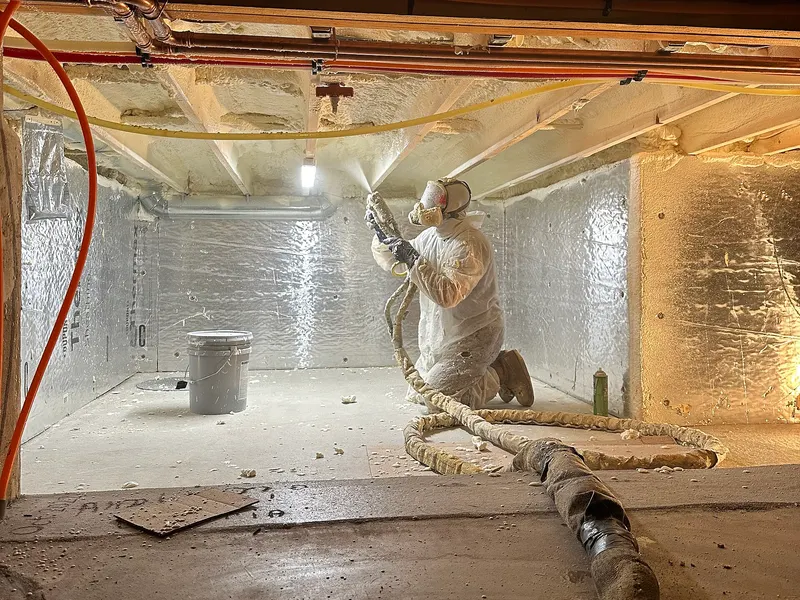
Spray foam: chemical mixing, protective gear and re-entry times make it a pro job
Dense-pack walls in finished homes
Anything with vermiculite or other suspect material: test first, then an accredited abatement contractor
Rodent-soiled insulation removal in attics or crawl spaces
Knob-and-tube wiring or old recessed lights in the attic: get an electrician first
Blower door testing and AeroBarrier
Spray foam goes on in full protective gear. Photo: Jeskola26, CC0, via Wikimedia Commons.
Questions to ask before you hire
On the phone
What’s your CCB number, and are you bonded and insured?
Are you an Energy Trust trade ally, and will you file the incentive paperwork?
Do you do the air sealing yourselves, or only insulation?
Do you test with a blower door before and after?
Who will be in my attic or crawl space: your crew or a subcontractor?
On the quote
Which product, at what depth, and what final R-value?
How many square feet, and is air sealing itemized?
Baffles at the eaves, insulated hatch, bath fan ducts sealed and vented outside?
What happens to old or damaged insulation?
For spray foam: open or closed cell, ignition barrier and re-entry time?
What’s guaranteed, and for how long?
Ask for a depth marker (attic ruler) stapled to a truss after a blown-in job so you can see the installed depth later.
Insulation in Bend: FAQ
How much attic insulation do I need in Bend?
Bend is in climate zone 5. ENERGY STAR recommends R-60 for an uninsulated attic in zone 5, or adding up to R-49 if you already have 3–4 inches. Oregon’s residential code requires R-49 for flat ceilings in new homes. Energy Trust pays its attic incentive when existing insulation is R-18 or less and you insulate to at least R-38.
Does Energy Trust of Oregon pay for insulation in Bend?
Yes, if your home is mainly heated by Pacific Power electricity or Cascade Natural Gas. Owner-occupied single-family homes get $1.25 per sq ft for attic insulation, $0.75 per sq ft for floors and $1.50 per sq ft for walls, with higher rates for rentals and income-qualified households. Apply within 60 days of installation. Homes heated by Central Electric Cooperative or Midstate Electric power don’t qualify for Energy Trust and should check their co-op instead.
Is there still a federal tax credit for insulation?
No, not for new work. ENERGY STAR lists the insulation credit (30% of product cost, up to $1,200 a year) as applying to products purchased and installed between January 1, 2023 and December 31, 2025. The July 2025 federal tax law (the One Big Beautiful Bill Act) ended it for anything placed in service after 2025, so a 2026 project doesn’t qualify.
Are Oregon’s federal home energy rebates (HEAR) available yet?
Not to homeowners as of October 2026. Oregon’s rebate site says no rebates are currently available, contractor enrollment opened October 12, 2026, and there is no set date for homeowner applications. HEAR is meant to cover insulation and air sealing for income-qualified households once it launches.
Do I need a permit to add insulation in Bend?
Possibly. The 2021 Oregon Residential Specialty Code listed retrofitted insulation as work exempt from a building permit, but the 2023 edition’s exemption list no longer names it. Ask the City of Bend Building Division (or Deschutes County outside city limits) about your project. Anything that opens walls in a remodel, adds bath fans or roof vents, or involves a reroof needs permits.
Spray foam or blown-in insulation for a Bend attic?
For an ordinary vented attic, air sealing plus blown fiberglass or cellulose is the usual answer and costs far less per R-value. Spray foam earns its price on rim joists, vaulted ceilings without much depth, crawl space walls, shops and pole barns, or when you’re converting the attic to conditioned space.
What does a Home Energy Score cost in Bend, and who needs one?
Inside Bend city limits, detached homes and side-by-side attached units must have a Home Energy Score from a state-licensed assessor on the listing when they go up for sale, with some exemptions. Get My Home Energy Score posts 2026 prices of $235 up to 1,500 sq ft, $250 for 1,501–2,500 and $280 for 2,501–3,000. The city offers free scores to sellers under 80% of area median income.
Can I get free insulation if my income is limited?
Possibly. NeighborImpact’s weatherization program serves Deschutes, Crook and Jefferson counties, renters and owners alike, with air sealing, duct sealing, insulation and safety work after a 3–4 hour energy audit. Central Electric Cooperative members at or below 60% of state median income can get free to low-cost weatherization through CEC. Energy Trust also has higher incentives through Savings Within Reach.
Should I remove old insulation before adding more?
Only if it’s wet, moldy, soiled by rodents or crushed. Otherwise, air seal and blow new insulation on top. If you see pebbly vermiculite, don’t disturb it; have it tested first, and use an accredited asbestos contractor if it needs to come out.
How do I check an insulation contractor’s license?
Oregon requires contractors to be licensed by the Construction Contractors Board. Search the name or number on the CCB license search, and make sure the license is active and the name matches your contract. Every contractor on this page matched an active CCB license on October 23, 2026.
Contractor details come from each company’s own website (linked on its card), and licenses from the Oregon CCB’s active-license data, checked October 23, 2026. Incentives change, so confirm before you sign.