House with lap siding and white trim

Bend project guide · Exterior

Siding Installation & Replacement in Bend, Oregon

New look, tired paint, failing old siding or water damage: how Bend homeowners choose between fiber cement, engineered wood, cedar and metal, and what separates a siding job that lasts 30 years from one that rots in five.

Best season: May–OctoberFiber cement is the Bend defaultUpdated October 19, 2026

Start here

What brings you here?

Bend Local Services FinderWant a few names for this exact job?

Tell us what you are planning and we'll point you to up to three Bend-area pros who actually take this kind of project.

Get local quotes
Made for BendLocal research. Useful context. No fluff.
Part of our Bend general contractors guideUpdated October 19, 2026

Why Bend homeowners replace siding

Updating the lookSwapping dated siding for board-and-batten, mixed materials or a modern metal accent can transform curb appeal.Plan the trim too
Tired paint and stainWood and older siding in Bend sun can need repainting or restaining every few years. New, low-maintenance siding ends that cycle.Factory finishes help
Failing old productsMany Bend homes from the 1980s and 1990s have composite hardboard siding that swells and crumbles once water gets in.Usually time to replace
Wildfire resilienceAll of Bend is a designated wildfire hazard zone. Noncombustible siding is one of the bigger hardening upgrades.Hardening guide
Energy and comfortA re-side is the best chance to add exterior insulation, air seal and flash windows properly.Ask about continuous insulation
Water damageRot, swelling and stains mean water is getting behind the siding. Fix the source along with the boards.Jump to rot

Siding materials for Central Oregon

MaterialGood forWatch for
Fiber cement (James Hardie and others)Rot, insect and fire resistance; holds paint in strong sun; many profiles. The most common choice in Bend.Heavy; must be installed to the manufacturer's instructions to keep the warranty. Cutting creates silica dust.
Engineered wood (e.g. LP SmartSide)Lighter and easier to handle than fiber cement, real wood texture, usually lower cost.Combustible. Cut edges and clearances must be sealed and maintained.
Cedar and natural woodClassic mountain look; easy to repair board by board.Needs restaining often in Bend UV; combustible.
Metal panels and lapModern look, noncombustible, very durable, low maintenance.Corners and openings need careful detailing; can dent.
VinylLowest cost.Less common in Bend; can warp in strong sun and offers little fire resistance.
Stone or stone veneerAccents at the base of walls, entries and columns.Needs a proper drainage gap and flashing behind it.
Mixing materials is very Bend. Lap siding on the body, board-and-batten or panels in the gables, and a stone or metal base is a common look here. The base detail also helps with snow, splash and fire resistance at the bottom of the wall.

Fiber cement (Hardie) siding in Bend

If you ask around Bend about new siding, you will hear "Hardie" a lot. James Hardie is the best-known brand of fiber cement siding, a mix of cement, sand and wood fibers. It does not rot, insects do not eat it, it is noncombustible, and it holds paint far better than wood under high-desert sun.

The product family

  • HardiePlank: lap siding, the most common profile, in smooth and wood-grain textures.
  • HardiePanel: vertical panels, often used with battens for a board-and-batten look.
  • HardieShingle: shingle-style siding, popular in gables.
  • HardieTrim: matching fiber cement trim for corners, windows and fascia.

Cold-climate versions

James Hardie makes its siding in two climate versions under its HardieZone system. The HZ5 line is designed for colder regions with freezing temperatures, snow and ice, which describes Central Oregon. Ask your contractor which line they are installing.

Factory finish or painted on site?

  • Factory finish (Hardie's is called ColorPlus): baked on, consistent color and no painting step. Usually lasts longer before repainting, a real advantage in Bend sun.
  • Primed and painted on site: any color you want, easy touch-ups, and you can repaint later. Expect to repaint sooner.

What to ask a fiber cement installer

  1. Are you trained or certified by the manufacturer, and will the install qualify for the full product warranty?
  2. Which product line (HZ5) and finish are you quoting?
  3. How do you handle clearances from the ground, roofs, decks and hardscape? (The manufacturer specifies these; skipping them is a common cause of failures.)
  4. How do you cut it? Cutting fiber cement makes silica dust; good crews use dust-collecting saws or shears and cut outdoors away from open windows.
  5. What fasteners and nailing pattern do you use, and how do you seal cut ends and butt joints?
  6. Is trim fiber cement too, or wood? (Wood trim next to fiber cement is a weak spot.)

How Bend's climate is hard on siding

  • Strong sun. At 3,600+ feet, UV breaks down paint, stain and caulk faster than in the valley, especially on south and west walls.
  • Big temperature swings. 30 to 40 degree swings between day and night expand and contract boards and open joints.
  • Snow against walls. Snow sliding off roofs or plowed off driveways sits against the bottom courses for weeks, melting and refreezing.
  • Sprinklers. Irrigation heads spraying siding all summer are one of the most common causes of rot we hear about.
  • Wildfire season. Embers collect at the base of walls. A noncombustible base and noncombustible siding reduce that risk.

What a good siding job includes

  1. An inspection before the quote, including probing suspect areas and checking for interior stains.
  2. Unit prices for hidden damage: sheathing per sheet and framing repair per hour or per foot, so surprises are not open-ended.
  3. A new weather-resistive barrier (house wrap) lapped correctly, with taped or flashed openings.
  4. Window and door flashing tied into the new barrier, not just caulked. See our windows guide if replacement is on the table.
  5. Kick-out flashings where roof edges meet walls.
  6. Manufacturer clearances from soil, hardscape, decks and roofs.
  7. Vents and penetrations flashed, and ideally upgraded to ember-resistant vents while the wall is open.
  8. Photos of the open walls before they are covered. Keep them for your records and future buyers.
  9. Paint or finish clearly included or excluded, with cut ends sealed.
  10. Cleanup, including nails from the yard and dust control.
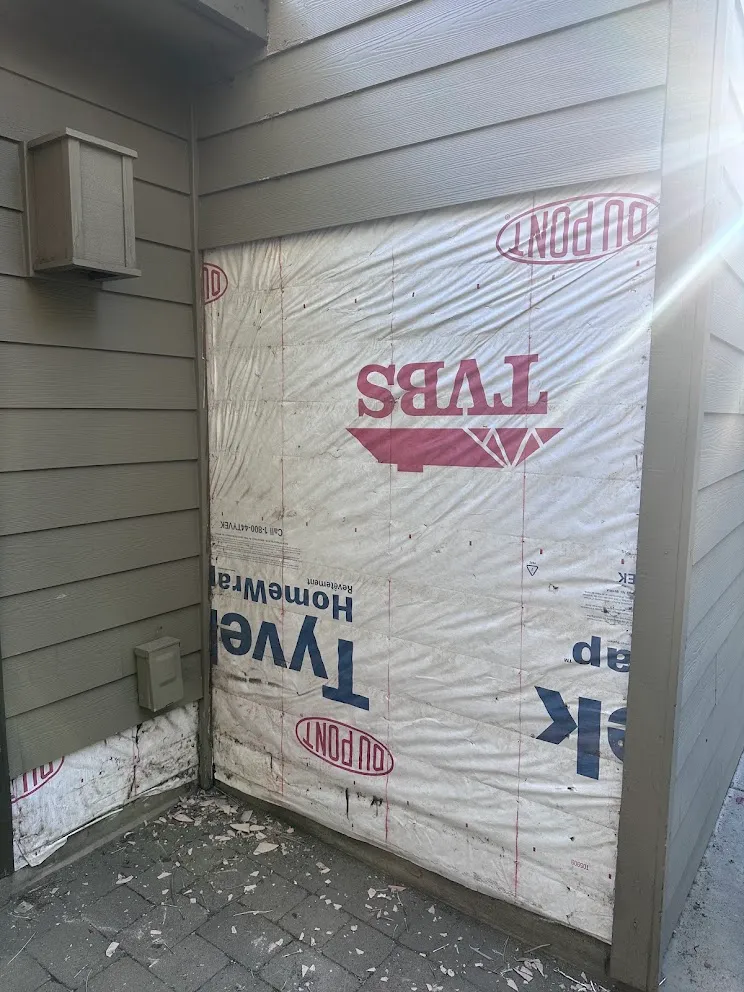
Exterior wall with the old lap siding removed, showing the Tyvek house wrap underneath and broken siding pieces on the pavers
Our photo of a Bend re-side in progress: siding off, house wrap exposed. This is the moment to check the wrap, the flashing at every opening and the sheathing behind it before new boards go on.
Timing: exterior work is easiest in Bend from late spring through early fall. Book early; good siding crews fill their summer schedules by spring.

Water damage and dry rot behind siding

Bend is dry, so people are often surprised to find rot. When they do, it almost always traces back to a few predictable water sources.

Warning signs
Swollen or flaking board edgesEspecially the bottom courses and near downspouts. Old hardboard siding swells and crumbles once wet.Probe it with a screwdriver
Stains under window cornersWater getting past the window flashing and running down inside the wall.Likely a flashing problem
Soft trim at doors and decksDoor trim, deck ledgers and stair stringers that touch siding are classic rot starters.Check the framing too
Paint that keeps peeling in one spotMoisture pushing out from behind the board. Repainting will not fix it.Find the water source
Musty smell or stains insideAlong an exterior wall. The wall may be wet from the outside.Call soon
Siding touching soil, rock or roofNo clearance means the bottom edge wicks water and snowmelt every winter.Fixable with a re-side
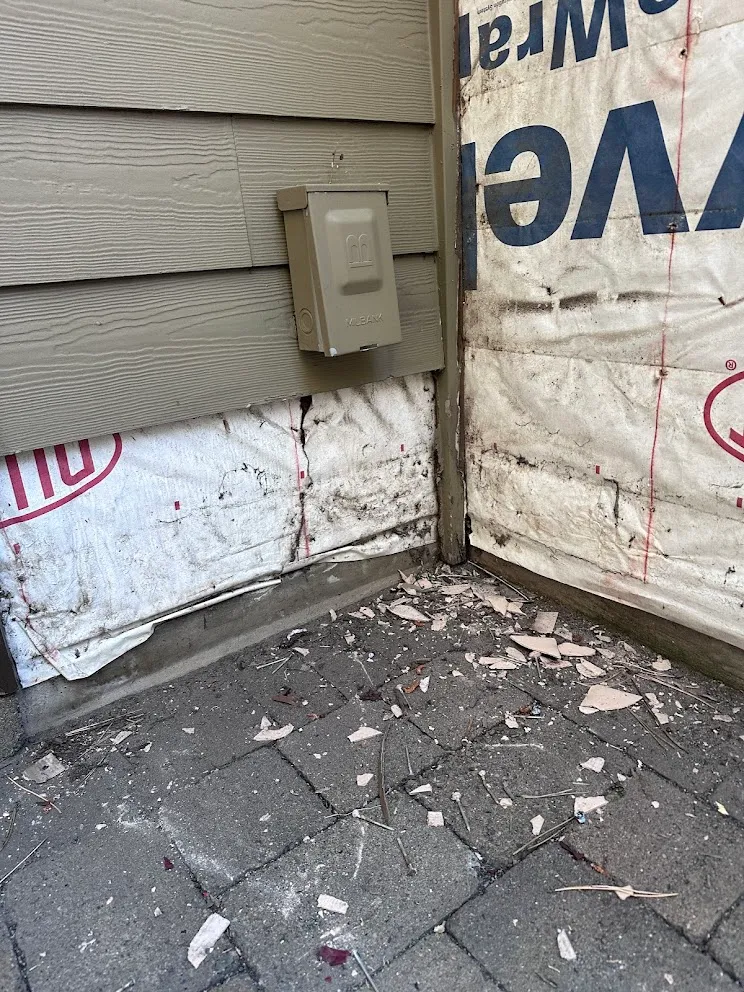
Bottom of an exterior wall with siding removed, showing torn and dirt-stained house wrap where the wall meets the patio pavers
Our photo: the house wrap at the base of the wall is torn and stained where it meets the pavers, the zone that sees splash, snow and sprinklers.
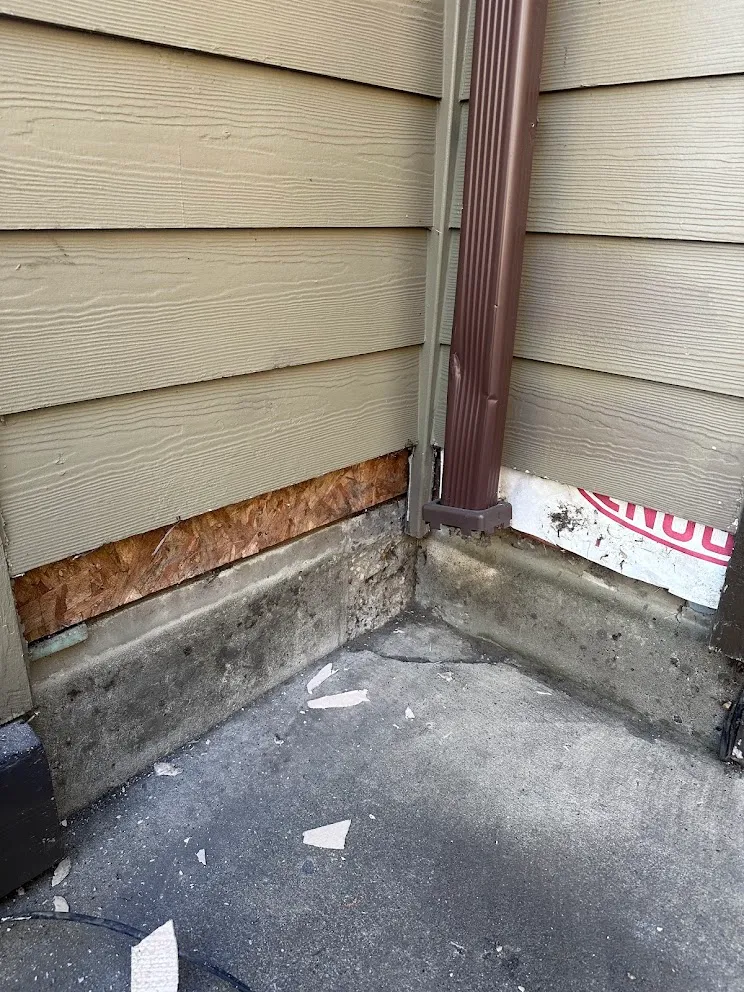
Bottom course of siding removed to expose OSB sheathing just above a concrete foundation, next to a downspout in the corner
Our photo: with the bottom course off, the OSB sheathing sits just above the concrete, right beside a downspout. Low corners next to downspouts are worth probing.

Where the water usually comes from

  • Missing kick-out flashing where a roof edge meets a wall, sending roof water straight down the siding. Our roofing guide covers this.
  • Window and door flashing that relies on caulk instead of sill pans and taped flanges.
  • Deck ledgers attached without flashing. See our deck builders guide.
  • Sprinklers and snow soaking the lower courses.
  • Gutters overflowing or dumping water against walls. See our gutters guide.

Repair a section or re-side?

Spot repair makes sense whenThe damage is limited to one wall, window or leak source, the rest of the siding is sound, and matching boards are available.Fix the water source first
Re-siding makes sense whenDamage shows up on several sides, the product is failing everywhere (like old hardboard), you are replacing windows anyway, or you want better fire resistance.Do it once, properly
Insurance: slow leaks and rot are usually treated as maintenance and not covered. Sudden damage, like a burst pipe, may be. If water has reached the inside of the house, see our water damage repair guide.

Our bottom line

For most Bend homes, fiber cement installed to the manufacturer's instructions is the safe, long-lasting choice, with engineered wood, cedar and metal as good alternatives depending on look and budget. Whatever you choose, the weather barrier, flashing and clearances behind and around the boards decide how long it lasts. Get unit prices for hidden rot, ask the fiber cement questions above, and have the open walls photographed.

Who to call

Bend contractors for siding projects

Listed in no particular order. Full re-sides often uncover rotted sheathing or framing, so look for a crew that can repair the wall, not just hang new boards. These builders from our GC guide fit that.

Remodeling + restorationBend and Central Oregon

Montgomery Remodeling and Restoration

Why for this project: Deep restoration and structural problem-solving background, which matters when old siding comes off and the wall behind it needs work.

Phone
541-371-2625
Read our full take
Whole-house remodelingBend and Central Oregon

Linnius Construction

Why for this project: Reviews repeatedly mention addressing unexpected issues openly, useful on re-sides where the scope can change once the walls are open.

Phone
541-388-0719
Read our full take
Design-build + restorationBend and Central Oregon

Sierra James Construction

Why for this project: Runs restoration and reconstruction under one roof, a fit when water has reached insulation, drywall or framing inside the wall.

Phone
541-306-3775
Read our full take
Decks & exterior projectsBend

Webfoot Home Improvements

Why for this project: Exterior and deck-focused crew, a practical call for trim, deck ledgers and siding repairs around decks.

Phone
541-390-0590
Read our full take

Specialists also worth a call

  • NKB Construction: Bend-area crew focused on siding (James Hardie fiber cement and cedar), windows and dry rot repair.
These are newer to our list and we have not reviewed them as deeply. Check the Oregon CCB license search and recent reviews before you hire.

FAQ

Common questions

What is the best siding for a house in Bend, Oregon?

Fiber cement (such as James Hardie) is the most common choice for new siding in Bend because it resists rot, insects and fire and holds paint well in strong sun. Engineered wood is a lighter, lower-cost alternative. Cedar and metal are popular for mountain and modern looks. Installation details matter more than the brand.

Is Hardie board the same as fiber cement?

James Hardie is the best-known brand of fiber cement siding, so "Hardie board" or "HardiePlank" is often used for fiber cement in general. HardiePlank is their lap siding; they also make panels, shingles and trim. Other manufacturers make fiber cement too.

Do I need a permit to replace siding in Bend?

It depends on scope. Replacing sheathing or framing, changing windows, or altering the structure can require a permit. Ask your contractor how they confirm requirements with the City of Bend Permit Center (541-388-5580) and get the answer in writing.

Should I get factory-painted or field-painted fiber cement?

Factory-finished fiber cement (James Hardie calls theirs ColorPlus) is baked on and usually holds color longer, with no painting step after install. Primed boards painted on site give unlimited color choices and are easier to touch up. In Bend's strong sun, many homeowners favor factory finishes for longevity.

How long does it take to re-side a house?

A typical single-family re-side takes one to three weeks depending on size, trim detail, windows and how much rot is found. Weather can stretch that; paint and sealants have temperature minimums, so late spring through early fall is easiest.

Should siding be replaced at the same time as windows?

If the windows are near the end of their life, yes. With the siding off, the installer can flash the window openings properly into the weather barrier, which is hard to do as well from the outside later.

More Bend project guides

Planning something else?

Every guide is part of our Bend general contractors guide.

Keep this guide useful

Did a Bend pro do this well for you?

Tell us who did your project and how it went. We check CCB licenses, reviews and project focus before adding anyone.