

Choosing a floor for a Bend home
Bend is hard on floors in its own particular way: dry air most of the year, strong high-altitude sun through big view windows, pumice dust and pine needles tracked in all summer, and snow, cinders and de-icer tracked in all winter. Add dogs and ski boots and you can see why the floor you loved in a showroom might not be right here.
| Floor | Best for | Bend watch-outs |
|---|---|---|
| Luxury vinyl plank (LVP) | Most rooms. Waterproof, scratch resistant, easy on a budget. Rigid-core types hide minor subfloor flaws better. | Big sunny windows can cause expansion and fading. Quality varies a lot; check the wear layer. |
| Laminate | Living areas and bedrooms. Very scratch resistant, realistic wood looks. | Many are water resistant, not waterproof. Not ideal for entries where snow melts. |
| Engineered hardwood | Real wood look and feel with better stability than solid wood. | Still scratches and dents; dry winters cause some movement. Only so many refinishes. |
| Solid hardwood | Long-term homes. Can be sanded and refinished many times. | Most sensitive to Bend's dry air: gaps in winter. Needs humidity control. |
| Tile | Entries, mudrooms, bathrooms, laundry. Shrugs off snow, grit and water. | Cold underfoot without radiant heat. Needs a stiff, flat subfloor to avoid cracks. |
| Carpet | Bedrooms and basements where warmth and quiet matter. | Holds pumice dust and pet hair. Many Bend buyers prefer hard floors in main living areas. |
Room-by-room picks
Carpet to LVP: what the job really includes
Swapping carpet for luxury vinyl plank is the most common flooring project in Bend right now, and it is the one we did ourselves. LVP is waterproof, shrugs off pine needles and pumice dust, and handles dogs and kids better than carpet. The planks are the easy part. The quote comes down to everything around them.
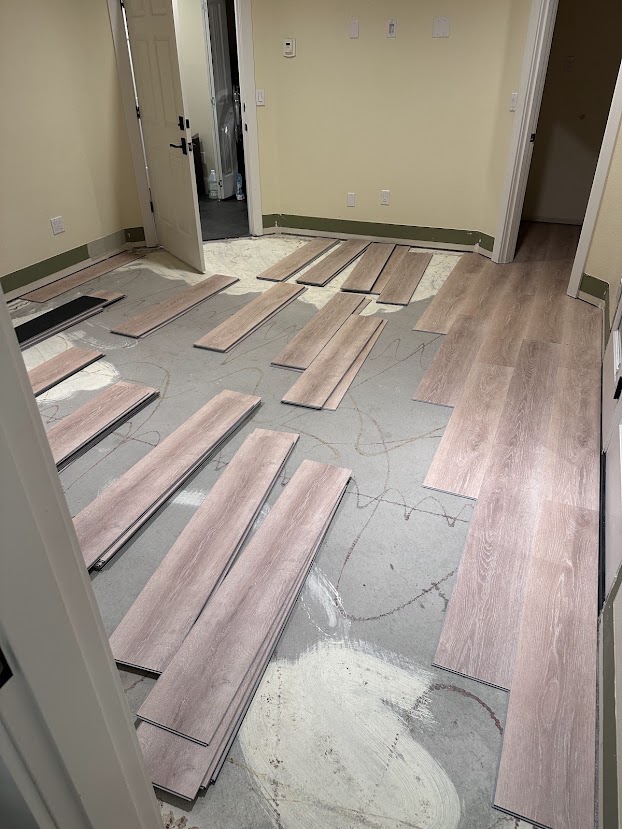
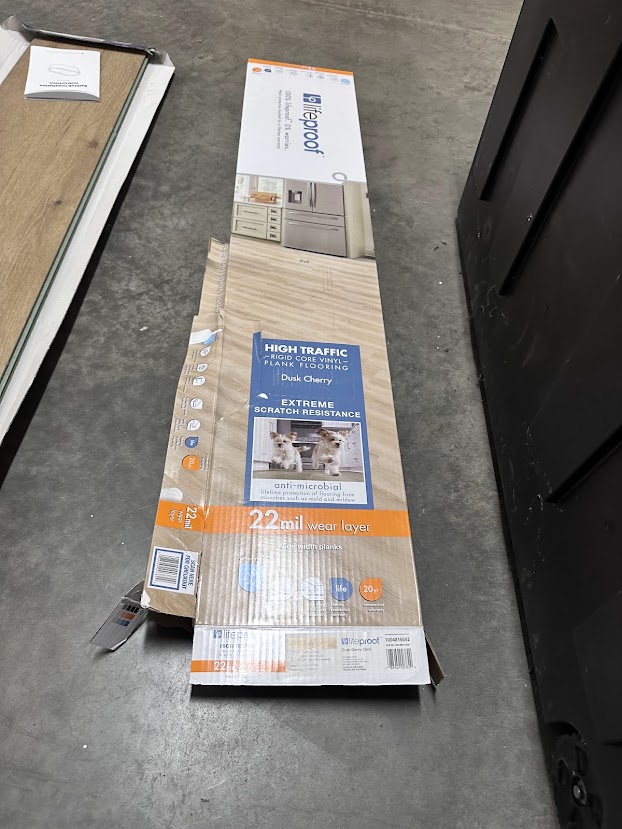
A complete carpet-to-LVP job usually covers:
- Moving furniture out and back (some installers charge extra, some exclude it).
- Tearing out carpet, pad and tack strip, plus hauling it away.
- Subfloor prep: pulling staples, screwing down squeaky or loose spots, grinding high spots and patching low ones, like the white areas in our photo. This step makes or breaks LVP.
- Underlayment, if the plank does not have one attached.
- Installing the planks with the correct expansion gap at walls, mixing boxes as you go.
- Undercutting door jambs so planks slide under the casing instead of being caulked around it.
- Baseboards or quarter round to cover the gap. Carpet hides a gap at the bottom of baseboards; hard flooring does not.
- Transitions to tile, hardwood or the next room.
- Stairs, which are their own line item: stair nose pieces, and often new treads.
- Doors that may need trimming if the new floor is taller.
Hardwood in Bend: engineered or solid?
Real wood is beautiful in a mountain home, but Bend's dry climate is the main thing to plan for. Indoor humidity drops very low in winter when the heat runs, and wood shrinks as it dries, opening gaps between boards. Then it swells again in the shoulder seasons.
- Engineered hardwood (a real wood top layer over a stable core) moves much less than solid wood, which is why many Bend installers recommend it.
- Solid hardwood can be sanded and refinished many more times, a plus in a forever home.
- Acclimation matters. Wood should sit in the house, with the heat or air running normally, for as long as the manufacturer says before it goes down.
- Humidity control, like a whole-house humidifier, helps wood floors stay inside the manufacturer's humidity range. Some warranties depend on it.
- Wider planks move more. Wide-plank solid wood is the riskiest choice in a dry climate.
For wood species, refinishing and a list of Bend hardwood specialists, see our hardwood flooring guide.
Laminate and tile, briefly
Laminate
Modern laminate is very scratch resistant and often looks more like real wood than vinyl does. Its weak spot is water: check whether a product is truly waterproof or only water resistant, and keep it out of entries where snow melts on the floor.
Tile
Porcelain tile is the toughest floor for entries, mudrooms, baths and laundry. It needs a stiff, flat subfloor (often with an uncoupling membrane) or it can crack. In Bend, pairing tile with electric radiant heat in a bathroom or entry makes cold mornings a lot nicer. For showers and full bath remodels, see our bathroom remodel guide.
Flooring materials calculator
Measure each room wall to wall, including closets. This gives you a box count to buy and a way to compare installer quotes on the same basis. It works for LVP, laminate, engineered wood and tile.
Keep one or two unopened boxes after the job. Colors and lots change, and a spare box makes a future repair invisible.
Where Bend houses make flooring harder
Subfloors that were fine under carpet
Carpet and pad hide a lot. Most hard-floor makers require a very flat subfloor (commonly no more than about 3/16 inch of variation over 10 feet; check your product). Many Bend homes built fast during the 2000s boom have OSB subfloors with humps at seams and squeaks where the glue let go. A good installer checks flatness with a long straightedge before quoting a final price, and tells you how leveling is billed if they find more than expected.
Slab floors and moisture
Some newer townhomes, ground-floor condos and converted garages have concrete slabs. Even waterproof LVP can trap moisture coming up through a slab, leading to mold or adhesive failure, and wood is worse. Ask whether they will test the slab and what vapor barrier they plan to use.
Big windows and high-desert sun
Bend gets strong, high-altitude sun, and many homes here are built around big south- and west-facing windows. Floating floors expand with heat. In a sunroom or a living room with floor-to-ceiling glass, cheap or thin LVP can gap, buckle at doorways or fade, and wood can fade or change color. Ask for a product rated for direct sun, respect the expansion gaps, and avoid pinning a floating floor with heavy built-ins or a kitchen island set on top of it.
Dry winter air
Low humidity affects wood the most, but it also matters for some laminates and for the gaps you see at trim. If you are putting in wood, plan for humidity control from day one.
Older homes: asbestos and lead
If the house was built before 2004 and there is old sheet vinyl or tile under the carpet in kitchens, baths or entries, Oregon DEQ rules generally require an accredited asbestos survey before a contractor disturbs it. If the home predates 1978 and the job involves sanding or removing painted trim, the contractor should be lead-safe certified. Owner-occupants doing their own work have different rules, but hired crews do not get that exemption.
Radiant floor heat
Some Bend homes and remodels have hydronic or electric radiant floors. Not every LVP, laminate or wood floor is rated for them, and those that are have temperature limits. Bring the system details to your quote.
How to compare flooring quotes
A low price per square foot can hide a thin scope. Line the quotes up against this list:
| Line item | What to ask |
|---|---|
| Product | Exact brand, line and thickness. For LVP, the wear layer in mils: 12 mil is a common minimum for busy rooms; 20 mil and up (like the 22 mil we used) is tougher. For engineered wood, the thickness of the real wood top layer. |
| Removal & haul-off | Old flooring, pad, tack strip and staples included? |
| Subfloor prep | How many hours or bags of leveler are included, and what is the rate if they need more? |
| Trim | Quarter round, shoe molding or new baseboard? Painted or primed? Who caulks and touches up? |
| Transitions | How many, and do they match the floor? |
| Stairs | Price per step, and are the noses flush-mount or overlap? |
| Appliances & toilets | Pulling the fridge, range, washer or toilets is often extra. Who reconnects water lines? |
| Acclimation & finishing | For wood: how long it acclimates, and for site-finished floors, how many coats and cure time before furniture. |
| Warranty | Manufacturer warranty on the product, and the installer's own labor warranty, in writing. |
Flooring company, general contractor or handyman?
Our bottom line
Pick the floor for the room, not the house: tile or tough LVP where snow and water land, wood or LVP where you live, and something soft where you sleep if you like it. Whatever you choose, the difference between a floor that looks great for fifteen years and one that clicks, gaps or cracks is mostly prep and installation. Pay for flat, ask the sun and humidity questions, and get trim and transitions in writing.